
Valentina Tanni, Interview with Bianco-Valente, 2002
Valentina Tanni: What strikes me about your research is the continuous blending of art and science, of a powerful and refined aesthetic sensibility with an almost experimental, laboratory-like attitude. Do you think what's called the "third culture" (precisely the product of the union of artistic and scientific culture) is a reality of our contemporary moment, or just a theory?
Bianco-Valente: The investigation into the complex dynamics active in our brain immediately led us to experiment with alternative ways of using computers and all the other electronic devices that current technology makes available to us.
The curious thing is that, just as happens in our brain, we work and experiment essentially on the software that lets us operate these machines, which without it would be little more than an assemblage of pieces of metal, plastic, and silicon.
So we find ourselves in a virtuous circle in which, in order to study the relationships between the human body and mind, we work our way into the relationships between a computer's hardware and software.
It's clear that, from our point of view, the only way to face the rigors of the technologized future that humanity is heading toward seems to be precisely not losing one's own humanity in front of machines, and learning to manage them without letting oneself be managed by them.
VT: Many scholars, from McLuhan onward, have attributed to the artist the role of "seismograph" of ongoing sociocultural mutations. Do you share this vision of art as a reflective force that anticipates changes in the world and in society?
B-V: In antiquity, and up until a few decades ago, this was certainly true, but now the feedback loop between tangible reality and the cathode-ray reality that the media smears daily across our retinas is too fast, and so it's honestly difficult to understand what the true inspiring source of the shifting trends in ongoing sociocultural dynamics really is.
It's certainly true that the visual artist, the fashion designer, the musician influence the vision of reality that the media present; but it's just as true that, at the same time, television and the internet influence, more or less profoundly, the way artists see the world.
And this is a loop that's difficult to interpret.
VT: Lately, even in art, technology is becoming increasingly "transparent"; in your installations, on the other hand, the computers are always "stripped bare," shamelessly showing the hardware and how it works. Where does this choice come from?
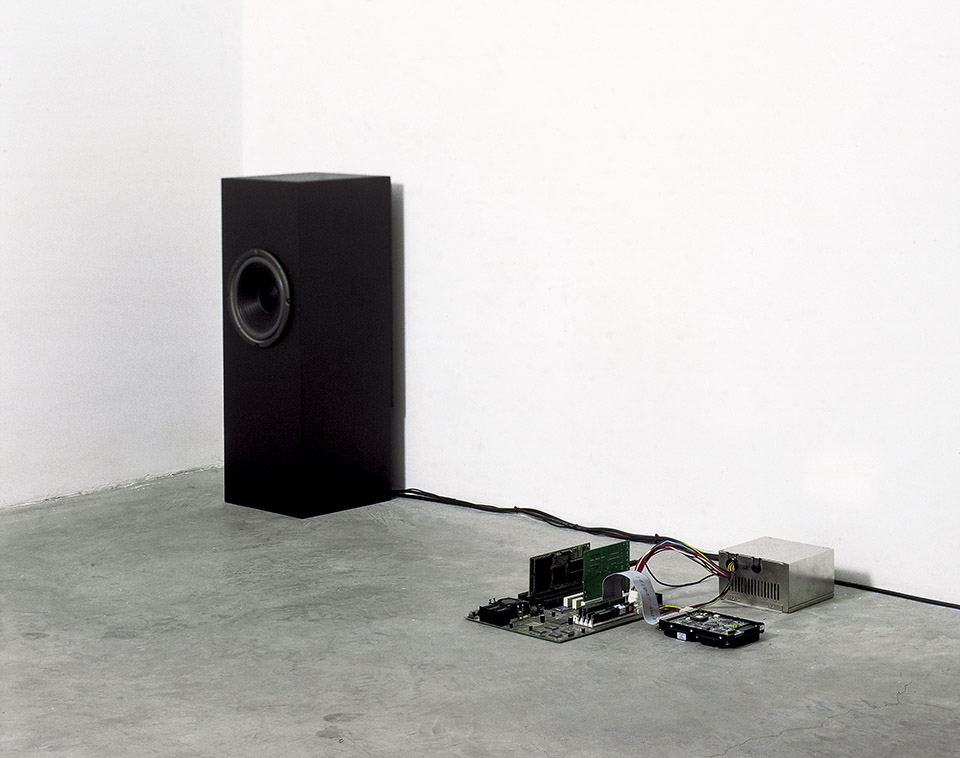
B-V: In the case of Breathless — a computer that reads some of our poems, which we've loaded into its memory, out loud in real time using its own synthetic voice — it was important for people to perceive that this unsettling voice, so warm and deep, was being generated at the very moment they heard it, by those circuit boards they saw assembled on the floor, through the logical processes taking place inside them.
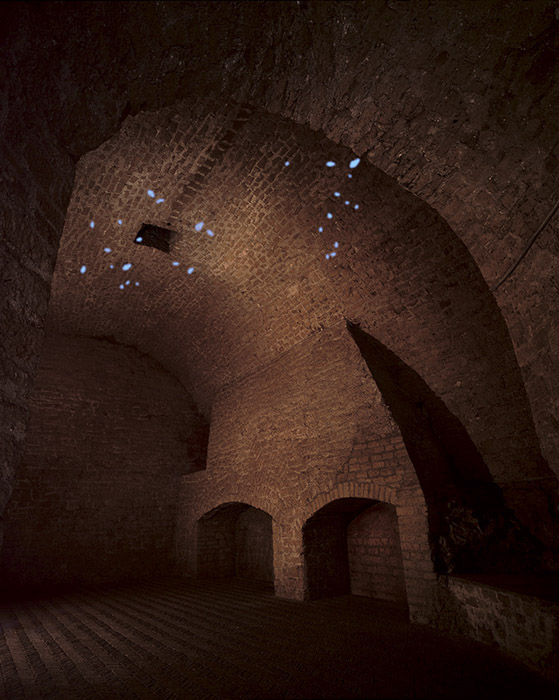
Similarly, in Volatile — again to highlight the paradox of artificial structures generating phenomena we perceive as natural — the computer, again assembled directly on the floor, generates a flock of birds that wheels freely across the ceiling by means of a video projection.
The 30 points of light standing in for the birds are free to move within a three-dimensional virtual space, though bound to follow only 3 simple rules that certain bird species are observed to follow in nature when flying in a flock. And so, just a second after the machine is switched on, the 30 points, randomly scattered across the screen, begin to wheel about, generating patterns that we immediately perceive as natural, even though they are merely the singular product of obscure numerical calculations.
VT: These last ten years have been decisive for the development of young Italian art. Years of intense ferment, of new proposals and research, and above all a renewed attention from critics and institutions. In this new scenario, the role of the artist also seems to have changed, gradually gaining ever greater autonomy and awareness. At this moment, in your view, what does it take for an artist to emerge, to make a name for themselves?
B-V: From what one sees around, it's certainly important to have the ability to relate to others and to position oneself within a relatively complex dynamic, in which various figures — other artists, gallerists, collectors, critics/curators, and publishers — can play a decisive role in helping the artist convey their work in the right way.
Paradoxically, in some cases, the requirement of innovative and/or high-quality work, if all the other conditions mentioned above are fully met, can even become an accessory quality rather than an essential one.
VT: What are you currently working on, and what are your commitments for the near future?
B-V: We recently opened Slow Brain at Galleria Antonella Nicola in Turin. All the works on show centered on the capacity certain chemical substances have to alter our perception of external reality, or the way that perception mixes with our memories and mental images — and thus on the relationships between the natural and the artificial.Anyone wanting to explore this further can visit the exhibition's website: Slow Brain.
At the moment, we're instead engaged in a very ambitious project involving the development of an artificial-life software, which will let us present a series of installations in public spaces, with works undergoing a slow but continuous random evolution that could, in theory, go on indefinitely — mirroring the same dynamics that the first single-celled organisms on Earth had to establish in order to give rise to the world as we see it now.
_
Taken from Exibart.com, March 1, 2002