
Working together on the "stigma" of Carrara's Caina district. Interview by Serena Carbone with Bianco-Valente
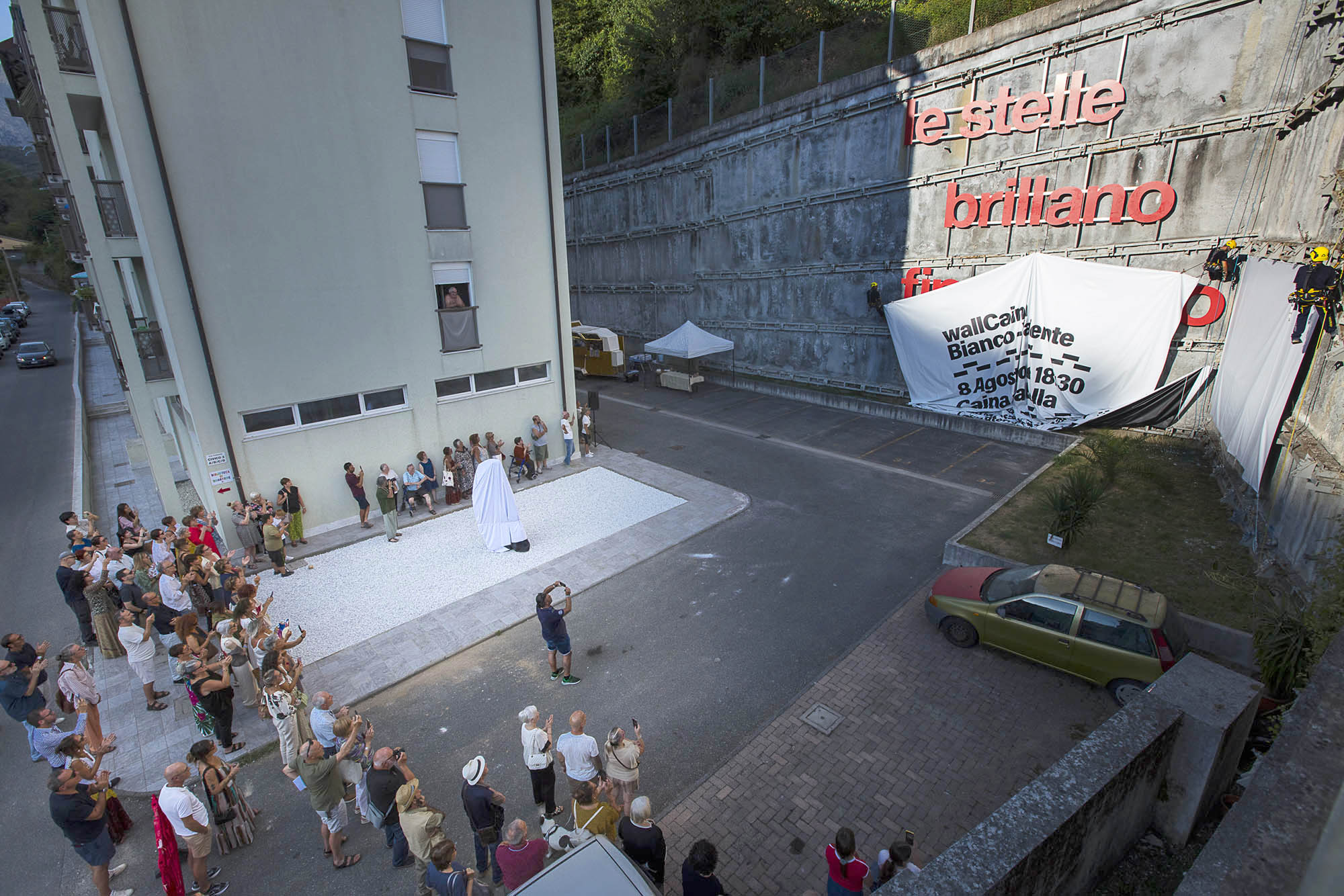
It is said that the name of Carrara's Caina district derives from the place name Cauvina. What is certain is that the public housing complex built right after the war to house the workers of the marble quarries still stands on the road leading from the city to the white marble. Here Bianco-Valente, a duo of artists based in Naples, active since the 1990s on the Italian and international scene, especially in the field of public art, created the work “The stars shine only as long as you look at them.”
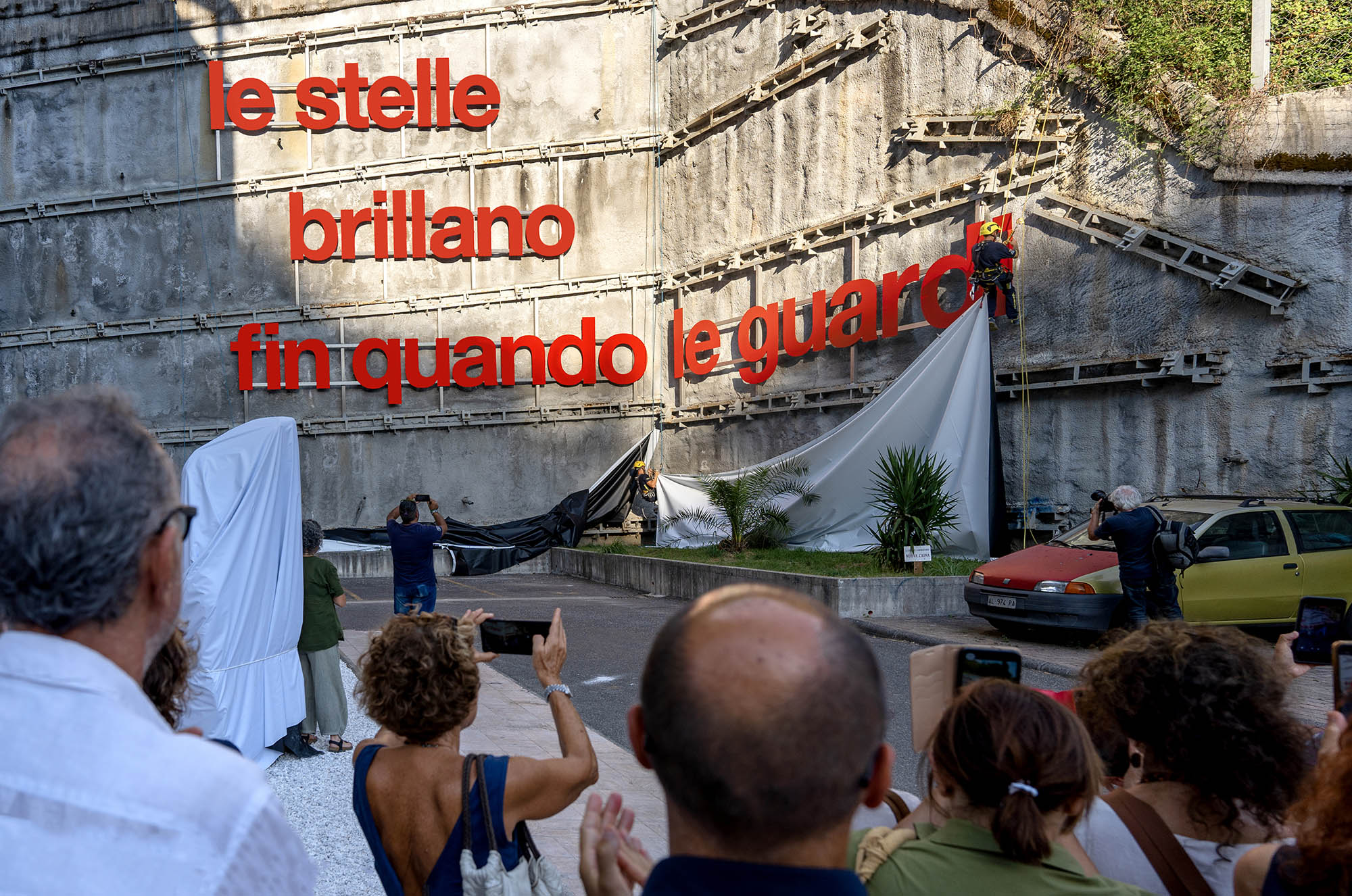
Serena Carbone: Tell me a bit, how did the project come about?
Bianco-Valente: The work was created as part of C.O.M (City Open Museum), a project funded with PNRR funds and led by the Academy of Fine Arts of Carrara. Within a very dense program that involved students and residents through workshops, talks, exhibitions, theatrical performances and concerts, our project also took shape, curated by Fabiola Manfredi, and it will be inaugurated together with Flavio Favelli's work Viceversa. A painting on stone.
S.C. Specifically, what were you commissioned to do?
B.V. The Director of the Academy, Marco Baudinelli, asked us to imagine an intervention aimed at enhancing the Caina district, to be put in dialogue with the retaining wall of the hill facing the buildings. The district, born after the war to answer a specific housing emergency, had over time turned into a place of decay and neglect. In 2011 the City Administration therefore decided to demolish the buildings with dynamite. Rebuilt on the same site, with more functional criteria, the buildings were handed over to residents in 2017. Since then the Nuova Caina Laboratory has worked to prevent the problems that had marked the district in the past: it nurtures relationships among residents, organizes meetings, shows and concerts, and, thanks to the residents' own participation, a neighborhood library was also born, which today holds more than a thousand volumes.

S.C. As is customary in your work, which mostly unfolds through relational practices grounded in engaging with a place and in dialogue with the people who live there, you used words.
B.V. In September 2025 we began the project with site visits in the district. The first meeting was with the Spazio Alber1ca Association, thanks to the willingness of Marina Babboni; her deep knowledge of the context, combined with solid experience in relational work, was a fundamental point of reference. Her contribution was decisive in establishing a dialogue with the Nuova Caina Laboratory (a project born within Spazio Alber1ca), which allowed us to meet the residents. We therefore let interaction with the place and with those who inhabit it show us the way. For some years we had been carrying an idea about the concept of beauty and about the fact that only what is lived, cared for and appreciated by people can be a source of light, and our encounter with Caina turned out to be the occasion to give that idea form as a work: The stars shine only as long as you look at them.

S.C. Were you inspired by anyone in particular?
B.V. We drew inspiration from a song by the musician and poet Enzo Gragnaniello, reworking a line from its lyrics.
S.C. What did you find distinctive about this district compared with the other contexts you've worked in?
B.V. During a meeting with the residents of Caina, the word stigma came up right away: the fear, for those living in an outlying public-housing district, of being singled out as a problem, a source of decay and wrongdoing, in a place people are reluctant to visit. We made it clear straight away that we are experts on stigma ourselves, living as we do in a stigmatized district (la Sanità) of a stigmatized city — but we also made clear that nothing good is born in historic centers flattened by gentrification. Beauty, and the stories that are then told and portrayed, are born from small (or large) everyday conflicts, from the forced coexistence with people whose approach to life is very different from your own.

S.C. What does working in relation to others mean to you today?
B.V. It's a thorny question. The part of the answer we'd stake anything on is that great respect is needed for the people one meets, and that one must be absolutely sincere in one's actions. The difficult part of the answer is that today, with the financial crisis gripping galleries and the exponential rise in funding channels for interventions in public space, we have entered a kind of homogenization: everyone does everything.
For us, working through interaction with places and people means leaving one's ego at home, together with the production methods typical of art conceived for galleries and museums.
_ _
Text published in Il Manifesto, 14 August 2026.