
Roberto Lacarbonara, Bianco-Valente. In the Shape of Time, 2019
There is no impassable boundary between us and things; we are at the center of the things we observe and manipulate, called into question by their offering themselves to our attention. Just as we are the landscape of a country, the imaginary of an image: we are the excess of what stands before us, visible, tangible, sayable.
Along this ridge Bianco-Valente's research "moves," in a movement that already contains the utopian and dialogic dimension of their narrative. Exploring the deep connections between people and places, tracing the relationships between identities, repositioning the gaze with respect to the non-trivial obviousness of everyday life, are tools of a radically political, ethical, philosophical methodology of inquiry, in which it is often language that is the only substance capable of giving physicality and form to thought.
When, starting from Predrag Matvejević's Mediterranean: A Cultural Landscape, the artists elaborated a panoptic table of all the shades of blue that dominate advertising photographs of our sea, arriving at a collage/color-field of the fantastical and the boundless (Breviario del Mediterraneo [Mediterranean Breviary], 2018), Bianco-Valente embarked on a cognitive route of great intensity, moving from images to the image, from the enormous mutability of natural data to its abstraction into a form of representation.
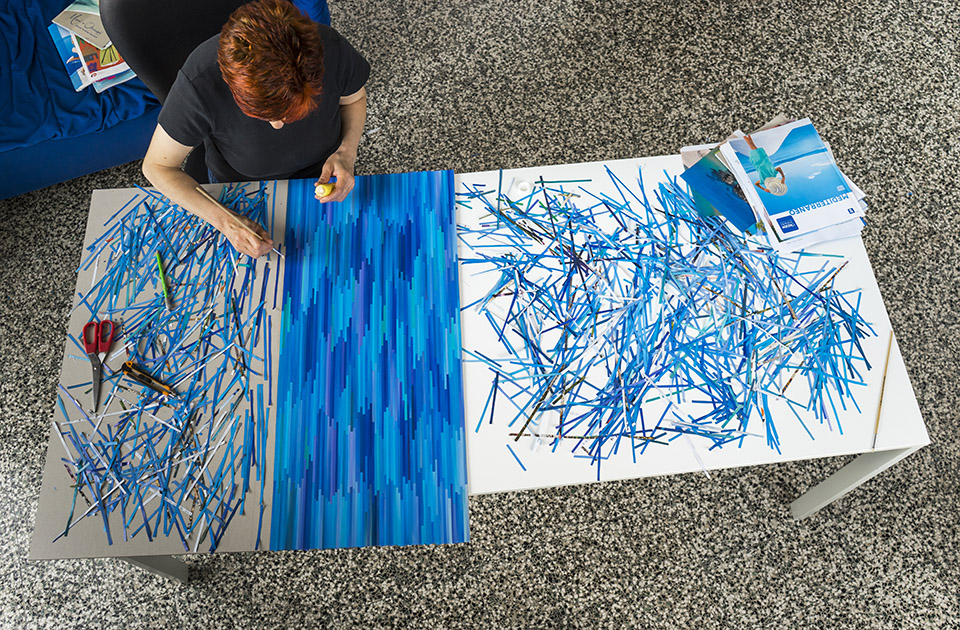
A path not unlike the work carried out in past years on maps (Terra di me [Land of Me], 2018; Illimite [Limitless], 2014), on flags (Nuovi arrivi, nuove storie [New Arrivals, New Stories], 2015), or — on the occasion of the residency-workshop in Polignano a Mare — on color pantones.
From the chance encounters with the inhabitants and tourists of one of the best-known towns in Puglia and the Mediterranean, there emerged a collection of colors capable of redesigning the essential properties of a landscape and its horizon, especially in the generosity of that Adriatic Sea which runs through the waters and skies of Pino Pascali and Domenico Modugno, the two celebrated artists native to Polignano, a place that presents itself through its color, through the breadth of its atmospheres and hues. But once again it is the trial of language that has made the imagination plastic and concrete.
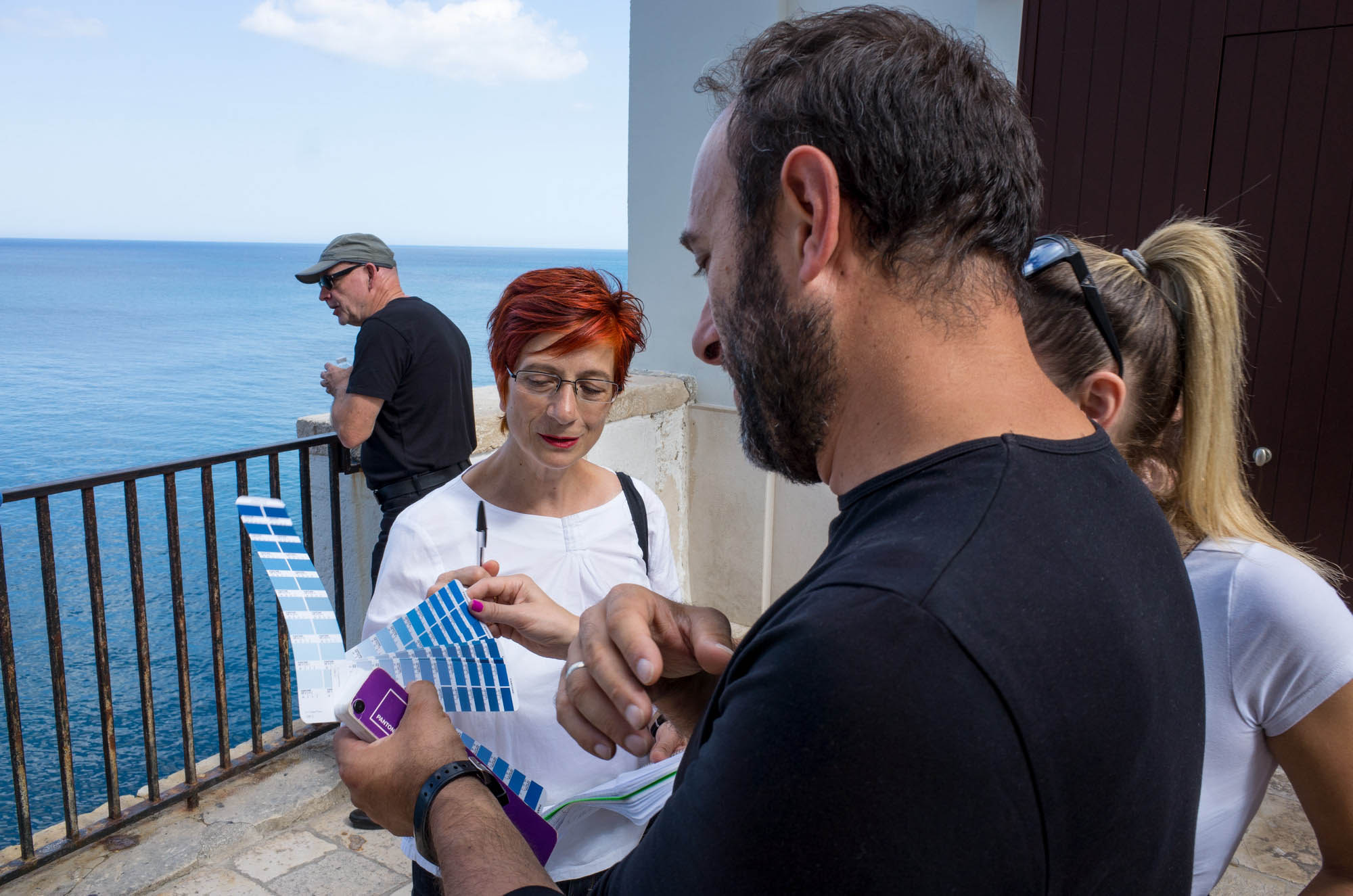
Each person interviewed became a source of the words that describe, indicate, analyze and criticize the town. Thus, from the many phrases that emerged during long conversations, a shared communication campaign took shape, capable of nodding to the quickness of advertising taglines while at the same time suspending the ostentation of the message, of the impulse to buy, and of desire.
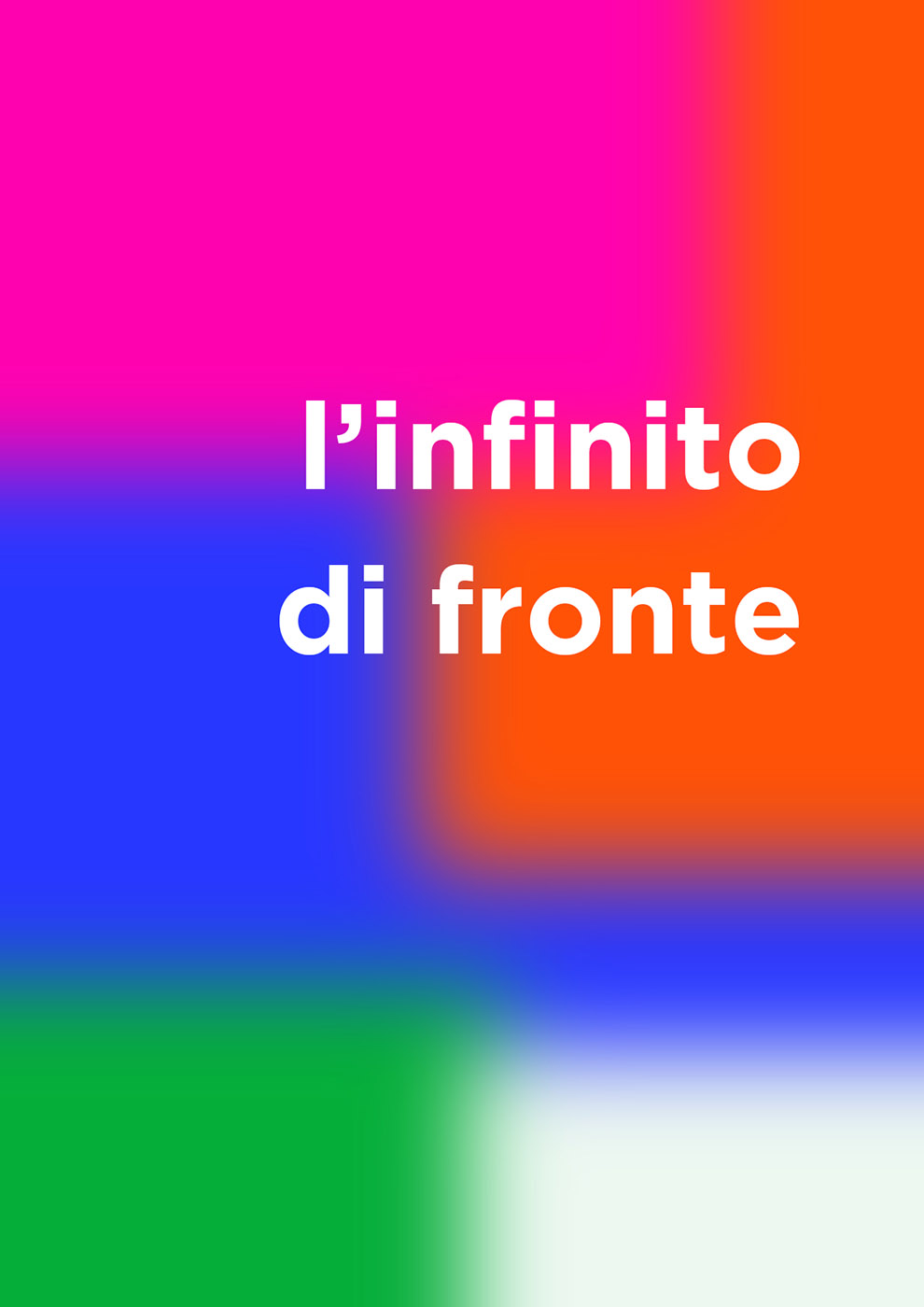
Bianco-Valente's posters sell nothing; they carry no addresses or dream destinations. They enunciate a panorama that does not exist except in the imagination of whoever, by reading and slipping into the color, generates their own horizon, their own land, their own way forward. This is how the imagination works, as literature teaches and art evokes: by means of a thought that each time recreates the world anew, in its own image and likeness.
There is then the environmental intervention carried out on the age-old cliff of Lama Monachile, among Europe's most popular "postcard" views. As in the experience of the Capri belvedere at Punta Tragara (2015) and the port of Acciaroli (2017), in Polignano too the artists traced, by means of a luminous installation, that "line of meaning that alters normal perception," a true overwriting of the place and of its customary representation. A forma di tempo (2019), the phrase that emerged from conversations with local residents and imprinted in the light of the installation, has the fossil strength of a thousand-year-old history and yet also the immaterial fragility of an evanescent light.
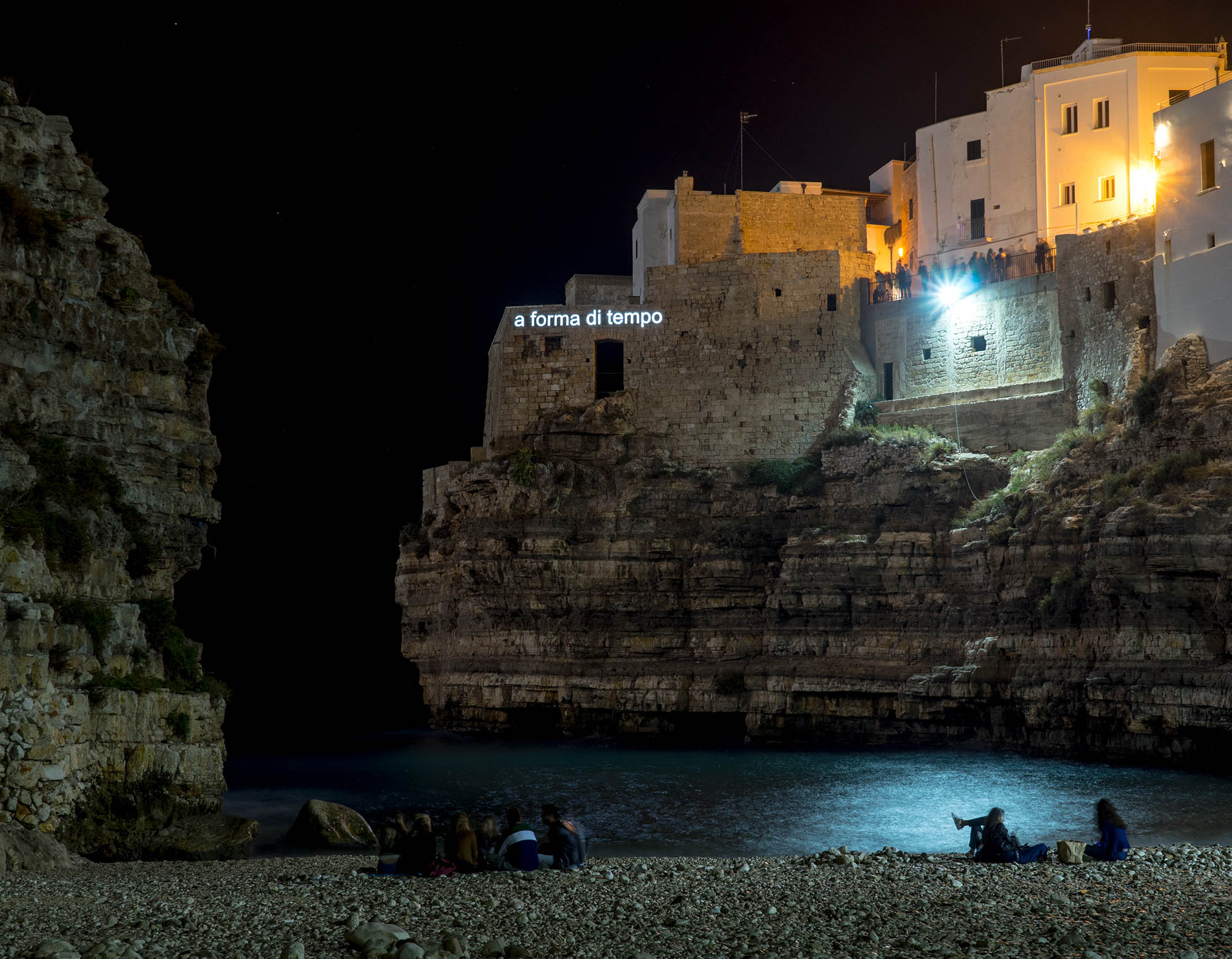
It is time, in its dual chronological and meteorological sense, that forges the surface of the world, laying down with geological patience its sediments and its wearing away.
And that phrase, placed there where the eyes trace the boundlessness of a Mediterranean horizon, immediately gives space back in the form of time, in that mutability of things and landscapes in which we are immersed, of which we are a part.