Francesca Santamaria & Sarah K. Kozlowski, Bianco-Valente, Il mare non bagna Napoli, 2015, 2025
Il mare non bagna Napoli, by Giovanna Bianco (b. 1962) and Pino Valente (b. 1967), consists of a line of words in capital letters, forged from iron and painted white, and installed at the edge of the rooftop terrace of the Madre Museum.(1) The terrace stages a panoramic view of the surrounding neighbourhood of San Lorenzo, with Vesuvius on the horizon and the sea just visible in the distance. From this privileged location, visitors recognise the most important buildings in the historic centre: to the right, the medieval church of Santa Maria Donnaregina and its baroque dome; behind it, the longitudinal body of the cathedral, from the facade to the apse, and the dome of the chapel of San Gennaro; to the left, the dome of the church of Santissimi Apostoli and its bell tower; and beyond, the dome and lantern of the church of Sant'Agostino alla Zecca.
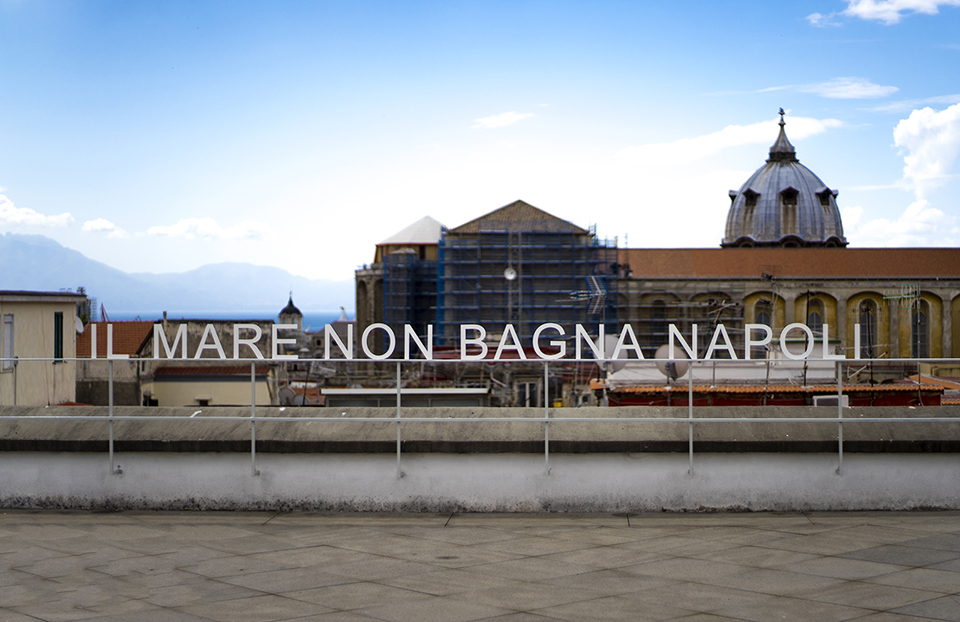
Bianco-Valente, Il mare non bagna Napoli, 2015, Environmental installation, Permanent collection of the Madre Museum, Napoli
The skyline itself is a palimpsest in which these historical buildings appear among modern structures, architectural accretions, and television antennae.
The words that make up the installation are drawn from the title of Anna Maria Ortese's book Il mare non bagna Napoli (The sea does not bathe Naples), which was published in 1953 and immediately provoked heated debate.(2) Ortese's collection of short stories and reportage portrays the difficulties and suffering of post-war Naples in a style that, as Ortese described it many years later, "has something of the exalted and the feverish; it tends toward the high-pitched, encroaches on the hallucinatory, and at almost every point on the page displays, even in its precision, something of the too much."(3)
Ortese's characters — not only the impoverished but also the bourgeoisie, aristocrats, and intellectuals — live in suffocating conditions, amid human misery, and find no way out. The paradoxical title, taken from a line in one of the book's stories, denies the sea as possibility or relief, as opening or horizon. Ortese's stories are as peripatetic as her life: she leads us through alleys, courtyards, and avenues, offering a sort of urban portrait, from the centre to the suburbs to the "involuntary city", as she calls the communities of displaced people who, after the war, lived in eighteenth-century granili or granaries. "Rereading those pages today", Bianco and Valente have observed, "one marvels at how relevant they remain, in particular when they describe the social dynamics that animate the city and that reveal the total disconnect between institutions, intellectuals, and a large part of the population, which is still relegated to a subsistence economy. We all inhabit the same places, but on completely different levels that only occasionally seem to intersect."(4)
The idea of Naples without the sea, which in Ortese's time was a provocation, has been increasingly investigated in contemporary scholarship and criticism, and several studies have discussed the complex relationship between the port and the city since the end of the nineteenth century, as the development of the port area resulted in its separation from the rest of the urban fabric.(5)
By joining the urban fabric with a line of text, Bianco-Valente propose a veduta that is made of the city itself — a view, however, that is both contradictory and unfinished, always in the process of being remade. Using the city as medium and a line of text as organising compositional principle, the work restages elements of the veduta tradition: the horizontal format, the commanding view from above, and the union of city, sky, and sea. But the linguistic play of the phrase "Il mare non bagna Napoli" removes the key element of the marine: the sea. Indeed, Bianco-Valente's installation turns on a disarming contradiction: it negates in language the sea that is in fact visible from the point of view of the terrace of the Madre Museum.
This contradiction immediately disorients the viewer, recalling in visual terms the experience of disorientation that Ortese's own writing provokes. (Ortese herself entitled the preface to the 1994 edition of the book "The 'sea' as Disorientation"). By using the physical fabric of Naples as a medium, captured from the visitor's actual point of view and physically present with its high domes and narrow alleys, where neither the sun nor the healthy sea breeze reach, the work presses viewers to consider the city more critically. For Bianco-Valente — the only artists among those discussed here who actually live in Naples — the city is complex, problematic, and unresolved. Il mare non bagna Napoli consists of the artwork itself but also the practice of caring for it. Every year the artists repaint the iron words, inevitably worn from exposure to the elements, a practice in stark contrast to the general abandonment of the city's cultural heritage by local and national institutions, as the view from the terrace reveals.
Veduta and city reimagined
Together, Jannis Kounellis' Untitled, William Kentridge's Naples Procession, Michal Rovner's Passages, and Bianco-Valente's Il mare non bagna Napoli represent diverse modes in which public, site-specific art in Naples over the past thirty-five years has engaged with the pictorial tradition of the veduta, and with the image of the city itself. At once drawing on and dismantling the formal, medial, and iconographic elements of the marine painting tradition, from the horizon line to the elevated point of view, these works open the genre to incorporate a range of mediums like found objects and materials, mosaic, video, language, and the built and natural environment itself. Moreover, although all of these works represent Naples as a port city defined by the meeting of land and sea, they offer diverse views of the city's identity, views shaped not only by the artists' visual and material poetics but also by the historical contexts in which the works were commissioned.
While Kounellis' installation dates to a period in which Naples was still confronting the destruction of its built heritage in the earthquake of 1980, the other works were made amid the city's contradictory renaissance, both reenergised and threatened by mass tourism. Kounellis presented Naples as a place where human and natural elements (jars, seawater, and blood) and modernity (steel and charcoal) coexist on different planes, developing a theme that ran through the Arte Povera movement, and perhaps reinforcing (if unintentionally) the image of Naples' alleged anti-modernity.
Twenty-five years later, Rovner imagined Naples as a welcoming Grand Tour destination to be explored and enjoyed, even if its details are elusive and ambiguous. It's not a coincidence that the work was conceived as part of the new "monumental port" area, an entry point for citizens and tourists into a prosperous and reconciled city, proud of its past and linked to the wider world by the sea.
Bianco-Valente's and Kentridge's representations of the city, meanwhile, offer complex visions in which conflicting forces shape and animate a multilayered palimpsest, where Naples' history is still a legacy to be confronted and questioned. Here, the artist's role is to make contradictions visible, even to the point of denying the presence of the sea. In this way, they reveal the city as a place where, as Chambers observes, one "liv[es] urban life as a problem, as an interrogation, as a provocation"(6) — a place that offers us new pathways by which to organise urban space, produce culture, and animate social dynamics, contesting the idea of a single, homogeneous modernity, and unsettling the serene horizon line of its representation.
Notes:
1) Giovanna Bianco and Pino Valente, Il mare non bagna Napoli, 2015, iron and paint, Naples, Museo Madre, presented by the artists as a long-term loan, acquired in 2022.
2) The book was published in 1953 by the publishing house Einaudi as part of the series edited by Elio Vittorini. On its controversial reception, see Lucia Re, "Invisible Sea: Anna Maria Ortese's Il mare non bagna Napoli", in California Italian Studies, vol. 3, no. 1 (2012), 1–18.
3) From the preface that Ortese wrote for the 1994 edition of the book, Anna Maria Ortese, Il Mare non bagna Napoli (Milan: Adelphi [1953] 1994), 9–10: "...ha un che di esaltato, di febbrile, tende ai toni alti, dà nell'allucinato: e quasi in ogni punto della pagina presenta, pur nel suo rigore, un che di 'troppo'..."
4) From the artists' statement published on their website, www.bianco-valente.com: "Rileggendo oggi quelle pagine si resta meravigliati di quanto esse siano attuali, in particolare quando descrivono le dinamiche sociali che animano la città e che vedono il totale scollamento fra le istituzioni, gli intellettuali e un'ampia parte della popolazione che è ancora relegata ad una economia di sussistenza. Abitiamo tutti gli stessi luoghi, ma su piani completamente diversi, che solo occasionalmente sembrano intersecarsi."
5) In addition to the aforementioned Stefania Palmentieri and Barbara Delle Donne, "La trasformazione del fronte marittimo di Napoli negli ultimi tre secoli", see also Annamaria Frallicciardi and Antonella Cuccurullo in Massimo Clemente, ed., Il mare e la città metropolitana di Napoli, 219–234. Chambers observed that "the sea remains an accessory, an appendage from which fish once arrived and urban effluence is now dispatched", Mediterranean Crossing: The Politics of an Interrupted Modernity, 84.
6) Iain Chambers, Mediterranean Crossing: The Politics of an Interrupted Modernity, 80.
_
Excerpt from: Reimagining the Neapolitan Veduta in the 20th and 21st Century City, TETI Journal No. 2 / 2025 Hybrid Marines