
Brunella Velardi In Dialogue with Bianco-Valente
Observing the great mosaic surface of Land Code, installed in a corner room of the former upper prison of Castel Sant'Elmo among the works of twentieth-century Neapolitan art, one has the impression that two powerful temporal waves — antiquity and the present — have met and broken against each other, crystallizing into the myriad stone tesserae that make up a vision at once familiar and anomalous. To try to decipher it, as in some ways the title itself invites us to do, one must first dwell on the elements it is made of.
The concept of code recurs in several of Bianco-Valente's works, as does the related concept of writing. It is the principle of a narrative that begins with the artist's voice and, along the way, is enriched by other voices, giving rise to collective, performative and installation-based projects in which the human, relational, natural and technological components intertwine in outcomes that always sit on the border between definitions and adjacent categories.
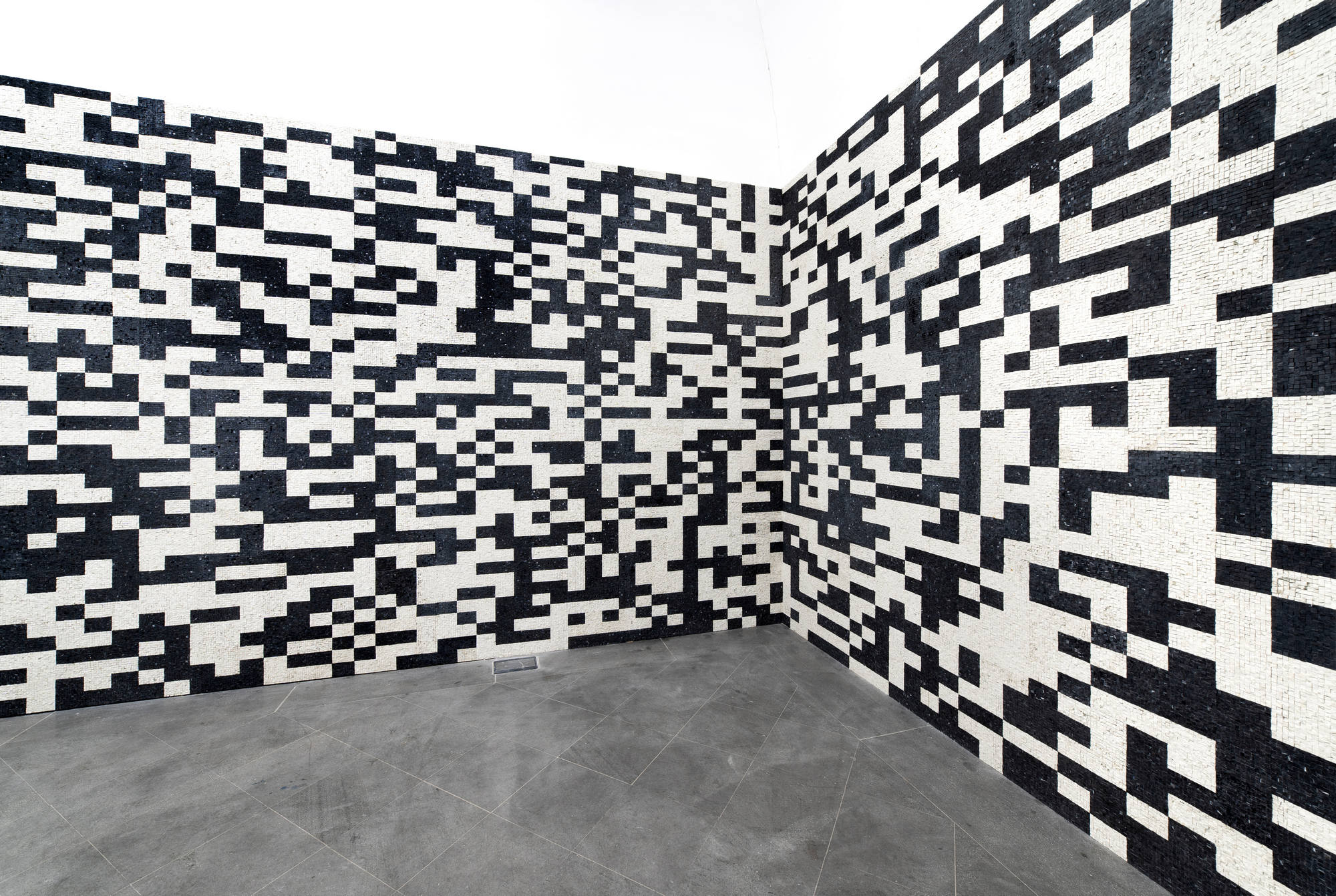
Within this narrative, space is characterized as the place where things happen and take hold: it becomes landscape, context (land, precisely). In this case, the choice to engage with the architectural surface links Land Code to works such as The Effort to Recompose my Complexity, Costellazione di me or Come il vento, whose possible common thread seems to be treating the wall as a palimpsest rather than a canvas, on which, in different ways, fragments of diverse nature are composed in an attempt to reconstitute parts of a lost unity.
Underlying it all is an idea of "system" that is undeniably at the root of the mosaic undertaking, but that also evokes a deeply contemporary imagination, permeated by the verbal and visual language of the digital.
Finally, the materiality of the stone tesserae is set against the intangibility of the virtual element commonly associated with the QR code, of which only a sort of moving imprint, a trace, remains here.
In the dialogue that follows, we try together with the artists to focus on these aspects, following the work that led to the project created for Sant'Elmo and tracing continuities and discontinuities with their research path.
Brunella Velardi The large mosaic in black and white tesserae that makes up Land Code, sliding across the walls of the Museo Novecento at Castel Sant'Elmo in Naples, is the result of an "archaeological research" that is relatively recent in your career, and which began with the eponymous open-air installation Land Code, created in Candela, in Puglia, in 2015, only to be taken up again in recent years. How did this interest in mosaic apparatuses and the testimonies of antiquity come about?
Bianco-Valente It all started with an impression we had several years ago, on a trip to the Azores, where in Horta we were enchanted to see entire sidewalks decorated with beautiful mosaics. What struck us most was the interplay between the local, volcanic stone, formed after a volcanic eruption, and the limestone imported from the mainland, creating a perfect harmony.
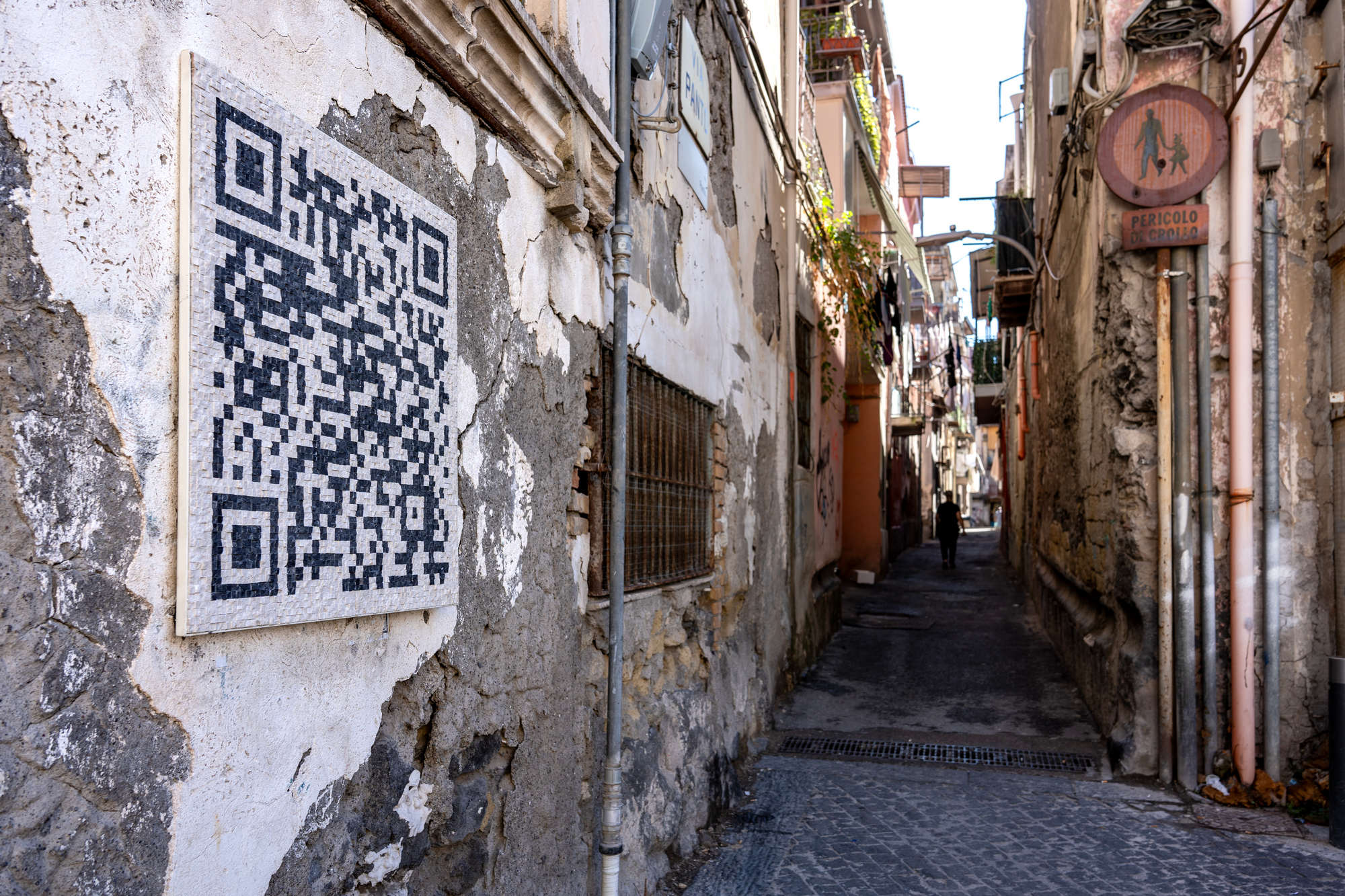
From there, some time later, came the idea of making a mosaic for the project we were developing in Puglia. We proposed a large-scale QR Code to be set up along the route of the ancient tratturo, once used for the transhumance of flocks. On that occasion we used black and white stones similar in size to the cobblestones we had seen in Horta, larger than the small tesserae used in mosaic decoration.

Brunella Velardi You recently inaugurated Connecting Code in Ercolano, a project that resulted in a series of works in urban space, including several mosaics. There the figurative element is present, whereas here an abstraction prevails that unsettles even every possible reference to geometric mosaic decoration. In what way is the chosen technique suited to two different aesthetic languages?
Bianco-Valente The development of Connecting Code, the project realized in Ercolano, lasted a year and, besides meetings and workshops with residents, we dedicated ourselves to exploring and getting to know the area, starting from the archaeological excavations, where on several occasions we were able to admire the splendid mosaics with moving natural scenes or elegant geometric compositions, used to decorate the floors and walls of the ancient city.
A votive offering made of many knots, of the kind used in seafaring, seen at the premises of a religious association devoted to the Madonna Dell'Arco, led us to think that the theme of the knot could be a meaningful way to bring out the strong bond the people of Ercolano feel for their own territory. This all led to a collective performance, in which two people at a time tie two ropes together, each using only one hand, symbolizing both the difficulty and the great opportunities that can be seized by learning to work together. Six drawings depicting these performances were engraved on marble slabs, later set into the parapet overlooking the Archaeological Park. For the market area, instead, we created a mosaic depicting a large knot made of many intertwined ropes. In addition to the usual marble tesserae, the work is enriched with porcelain tesserae obtained from everyday objects (vases, cups, plates, etc.) donated by families from Ercolano, who thus become part of this representation, which symbolically expresses the bond between people and the place where they live. The last work, a mosaic depicting a functioning QR Code, is likewise metaphorically a knot, the threshold between the real life it overlooks and the immateriality of the website it links to, where we recounted the entire development of the project through texts and images.
This last mosaic shares with the work designed for Castel Sant'Elmo our intention to set an ancient technique, based on the use of a material element such as stone, against an immaterial, contemporary domain of pure abstraction.
Brunella Velardi In terms of typology, Land Code fits into the long series of installations you have created over the course of your career. What kind of relationship are you interested in establishing with the spaces you engage with?
Bianco-Valente We design our interventions by contextualizing them to the spaces that will host them; for us, scale in an absolute sense has little relevance, as long as it is consistent with the space. Indeed, even a small work, or one entirely devoid of physical matter, such as a performative act, can stimulate a profound interaction with whoever experiences or perceives it, and this, for us, is precisely the essential aspect that should characterize every artistic intervention.
The work for Castel Sant'Elmo had originally been designed for an outdoor wall in Piazza d'Armi, where visitors would have been able to perceive it while also taking in the sea with their gaze.
For the new location in an indoor room, we chose not to install it on a single wall, but instead to create an illusion of movement, extending the work asymmetrically across two walls, giving it a greater dynamism.

Brunella Velardi Thinking about your interest in the electronic image, some of your earliest works come to mind, such as Slow Brain or JSR. What did digital aesthetics reveal then, and what does it reveal now?
Bianco-Valente At the start of our research we were interested in investigating brain dynamics, trying to stage them through static or moving images that were typically indefinite, volatile and low-resolution, qualities characteristic of mental images. Even though we used the electronic means available at the time, our goal was not to pursue a mere "digital aesthetic," but to try to give body to the imaginative scenario animating our cerebral cortex.
Brunella Velardi In 2001, on the occasion of the exhibition Napoli Anno Zero. Qui e ora [Naples Year Zero. Here and Now], you presented Volatile, a luminous installation that was in dialogue with the tuff vaults of Castel Sant’Elmo, simulating the coordinated flight of a flock of birds based on computer input. Is there, for you, a line of continuity between the works of that period and the research you are carrying out now?
Bianco-Valente Volatile is a computer-based installation created during a period when we were interested in probing the workings of an artificial mind, comparing it with the laws of nature that have emerged from millions of years of biological evolution.
We had programmed a computer by setting the same three simple rules that certain bird species follow in nature when they form flocks. In trying to stage those ‘choreographies’ we witness when we see them wheeling through the sky, we meant to conceptually link an artificial element with a natural phenomenon.
In that period (in the early 2000s), our work was characterized by experimental research with a ‘scientific’ bent, but after reading some essays on the study of complex phenomena, our outlook on the world changed, leading us to embark on a path that brought us to intervene in public space and to involve people in participatory or environmental interventions, both characterized by a strong bond with the territory and its inhabitants.
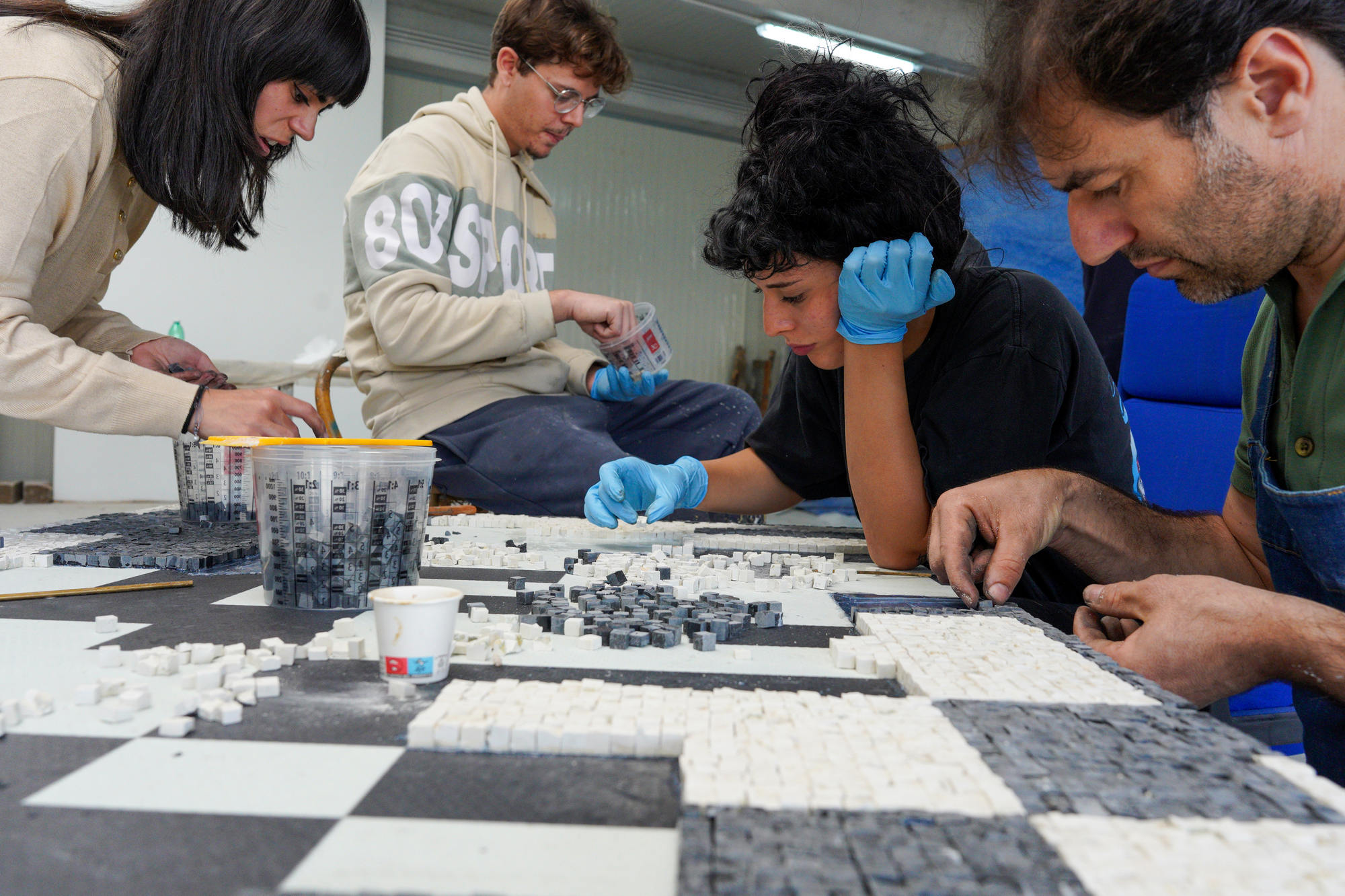
Even the work Land Code, designed for Castel Sant’Elmo, which appears to be a ‘silent’ work, is in fact the full expression of a choral effort, in which about twenty young artists placed hundreds of thousands of raw marble tesserae side by side, exchanging stories of their personal experiences as they worked. And it is interesting to read, in the very texture of this mosaic, the plurality of the characters of the people who helped compose it.
Brunella Velardi Although on different levels and with different ‘actors’, the search for connections between individuals, places, stories and objects has run through your work from the very beginning. Encounter, we might say, is the raw material of many of your works, which, not by chance, especially in recent times, have often revolved around the themes of the Mediterranean, migration, and the encounter between cultures. I would say that the mosaic, by its nature and history, evokes an imagination far broader than a mere reference to the remains of Pompeii and Herculaneum. Here too, there seems to be a stratification, the idea of a grafting of memories?
Bianco-Valente Works and artifacts in stone are, in all likelihood, the elements that best bear witness to the layering of history and the succession of human societies, bringing them into our present.
It is what remains of the past, allowing us to imagine the stories lived in other eras — what survives the passage of time. One is left fascinated to discover how strong our bond with the ancient is, a bond that is also reflected in the shapes of the objects we use every day.
Interview published in Land Code, edited by Bianco-Valente, Artem Edizioni, Naples, January 2025, 88 pp. ISBN 9788856910209