
Miriam Di Francesco, interview with Bianco-Valente, July 2026
The duo Bianco-Valente was formed in 1994. Their growing interest in scientific research and new technologies soon led them into the circuit of galleries and Italian contemporary art of the 1990s. Over time, their work also took shape through radical choices, such as staying in Naples while many colleagues moved toward the major art centers, breaking off relationships with galleries, and repeatedly redefining their own research themes.
The interview that follows, made up of temporal leaps and shifts in perspective, offers a viewpoint that is both oblique and coherent, questioning the very meaning of being an artist, then as now.
Miriam Di Francesco: Naples has always been the nerve center of your artistic career, at a time when cities like Milan, Bologna and Turin were experiencing great dynamism in the art world. Why this choice?
Bianco-Valente: Naples has always been the nerve center of many things, including art and culture; what has always been missing is the dynamism of the market, which instead was, and still is, more developed in the north of the country.
As for us, it's true — as a founding political choice of the Bianco-Valente project, we decided not to emigrate, unlike the previous three generations of our families.
Our artist friends who had moved from Naples to Milan and Bologna urged us to move north, where there were far more opportunities for an artist. And that was true. But coming from families with a history of migration that had continued for generations, we felt the need to stay, even at the cost of taking other paths. We could say that the Bianco-Valente project was born from this political stance
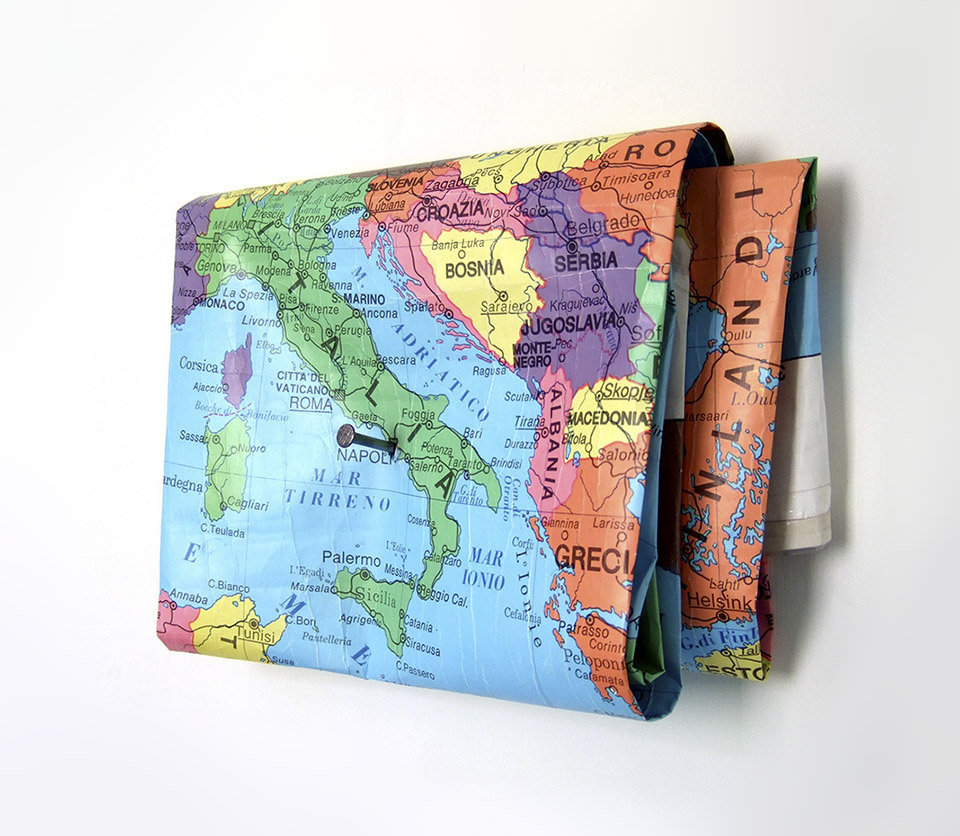
Bianco-Valente, Materia prima (Raw Material), 1994-2008, Geographic map and a 10-cm nail
MDF: Was it a stance taken in opposition to what was happening in the art system?
B-V: Yes, also driven by the fact that we were starting to notice certain distortions that characterized the contemporary art field. Consider more recent debates, such as the absence of Italian artists at the 2026 Venice Biennale and the issue of the scant consideration given to us Italian artists abroad — these are questions that point back to the responsibilities of those who ran the art world's information and financial systems: magazines, galleries, especially in the Milanese context.
Over time, specific choices were made, including politically motivated ones, that tended to marginalize everything south of Bologna.
Today it's hard not to recognize the consequences of those decisions, especially when you look at how certain names that had been heavily supported have held up internationally, and how they later struggled to gain even minimal recognition outside the national context.
MDF: Besides you, were there other forms of resistance?
B-V: We remember the role of the magazine Exibart, at the time directed by Massimiliano Tonelli, which was born as an online portal also with the intent of upending the dominant type of information and attention. This was possible thanks to a distributed editorial structure where each contributor worked from their own region, ensuring wider reach of information and a broader range of practices and contexts. Since everything was internet-based, it finally became possible to see many color photos of exhibitions, and this too helped represent artists' work adequately.
With Exibart first, and Artribune later, there was a contribution — at least in part — to rebalancing the informational dominance tied to the North. Alongside the magazines, some curators also began looking at other regional contexts, as in the case of Sergio Risaliti at the Palazzo delle Papesse in Siena.
Our own experience fits into this climate too: in fact, when we launched the A Cielo Aperto project, we didn't select artists based on their geographic origin, but followed a criterion of balance between North and South and between genders. It was an internal approach, never formally stated, but constitutive of the project itself.
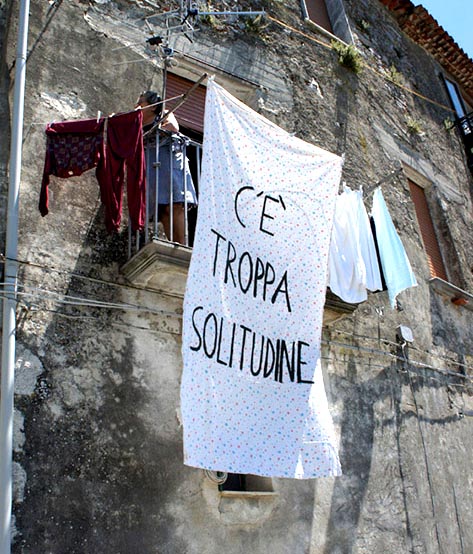
Bianco-Valente, Cosa manca (What's missing?), 2014, Roccagloriosa, Italy
MDF: Speaking of the A Cielo Aperto project, that too was an experience tied to place.
B-V: It's a project we believed in a great deal, born from the idea of working with the languages of the contemporary in close relation to the local context. The residencies involved multiple stays by the artists in Latronico, so the work could develop over time, through a relationship with the territory.
The central point was that the works should emerge from an encounter with the town and its inhabitants. It was a medium-term residency: after an initial phase of getting to know the context, the artist would conceive of an intervention that would then be carried out two or three months later. We conceived and co-curated A Cielo Aperto together with Pasquale Campanella, from its founding in 2008 until 2024, when we decided to no longer be part of the project.
MDF: Why?
B-V: The initial drive had physiologically waned over the years and, having glimpsed the possibility of a generational shift, we wanted to make room for the new curatorial team that was forming. Besides, by our nature, we don't like tying our name to a specific project with which we'd be permanently identified. Our path as artists is in fact marked by continuous evolution, which more than once has pushed us to take new directions — for example, in 2010 we left the Alfonso Artiaco gallery, steering our work more decisively toward public space and institutions.
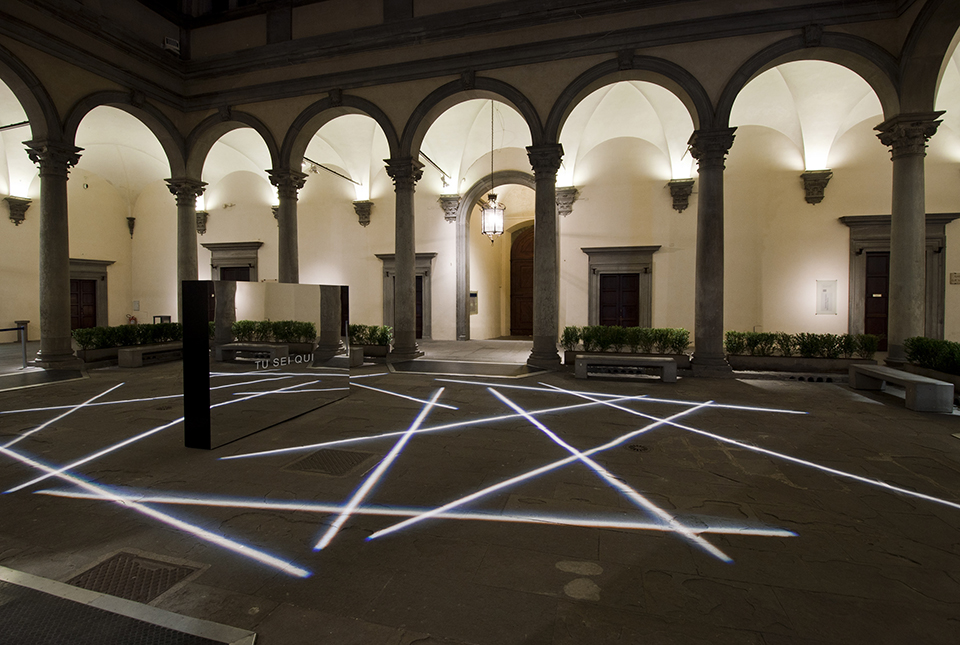
Bianco-Valente, Tu sei qui (You are here), 2015, Courtyard of Palazzo Strozzi, Florence
MDF: Besides your interest in public space, what else pushed you to take that path? What was happening in those years?
B-V: We were able to do it because in 2010 we were in the midst of a financial crisis, triggered two years earlier in the United States by the collapse of Lehman Brothers. At that moment, external conditions and personal choices intertwined: on one hand the economic crisis, on the other a direction we were already seeking. Sometimes these factors align and decisions become almost a natural consequence of circumstances.
MDF: I imagine it also takes a lot of courage to make such radical choices...
B-V: Of course, but it also takes a lot of courage to stay locked into one project for an entire lifetime.
MDF: And what did working in public space give you that the gallery couldn't? What need does artistic practice in local territories respond to?
B-V: The relationship with people has become increasingly central to how we carry out our interventions. Working in public space, in specific territories and with communities, means entering into a relationship with a specific context, bringing out the concerns and desires that belong to the people who live in those places. The works are born precisely from this relationship — they are not predefined, but always emerge from the encounter with people or from a study of the territory, and from the unpredictable evolution that characterizes every new project.
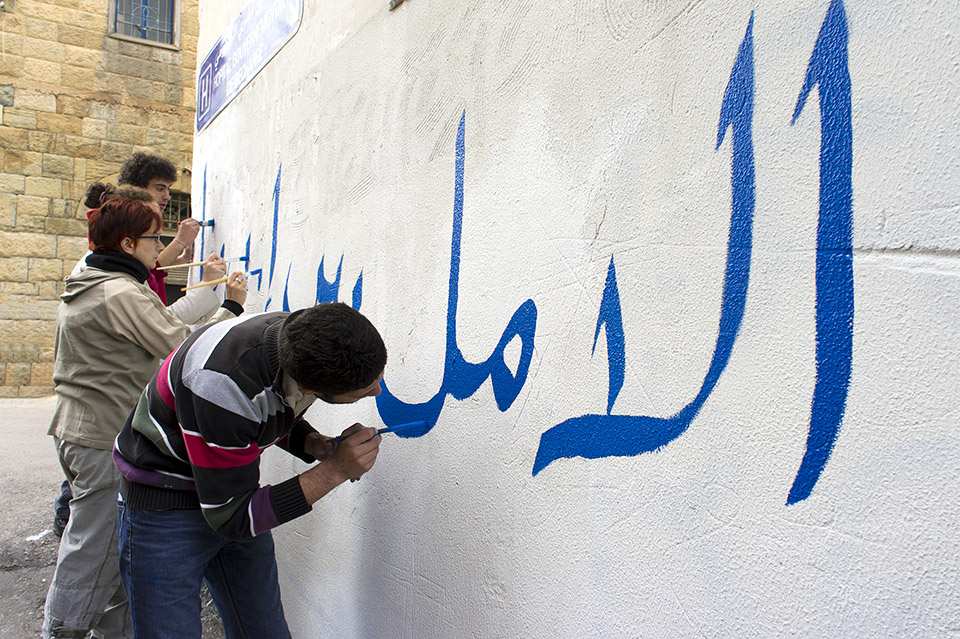
Bianco-Valente, Come il Vento (Like the Wind), 2013, Becharre, Lebanon
MDF: Did the relationship with people also include your fellow artists?
B-V: Speaking of the nineties and up through the early 2000s, so before the Lehman Brothers crisis, which was a real watershed — well-funded group shows were organized that allowed artists to be present both during the installation of the exhibitions and at the openings. In this context we got to know many artists, and relationships formed that then developed and were maintained over time. These are relationships that can't be perceived from the outside, partly because we live in different cities.
Still, meeting in such intense situations as the installation days made it possible to immediately sense whether there was a rapport or not. This condition has largely disappeared today. Exhibitions no longer have the same production budgets, travel has decreased, and artists often only travel to attend the openings.
Up until 2010, on the other hand, there was more continuity in the exchanges between artists, even though they came from different regions, and this generated a kind of common ground. It was a condition that also applied to curators, and it made more direct — and in a sense more authentic — encounters possible, both among artists and between artists and curators.
MDF: The 1990s were also marked by the advent of the internet and new technologies. How did technological innovation affect your work? What changed in your way of making art?
B-V: The advent of the internet and new technologies was fundamental, first of all in terms of getting our work out into the world, also thanks to the rise of magazines and portals dedicated to the contemporary. From the standpoint of our own production, it represented a great opportunity to broaden our areas of research and speed up the production of videos and video installations, which saw us move from “homemade” analog editing to digital editing.
Later, the subject of computers itself became an object of reflection. We made many works exploring the relationship between the individual — the human — and artificial intelligence, whose experimental research was gaining ground precisely in those years. Indeed, already in the early 2000s, we were asking ourselves whether a machine, through self-learning, could develop forms of intelligence and interaction comparable to human ones: how the mind works, the perception of external reality, memory, the ways experiences are reprocessed within relationships.
The central question was: if a machine can generate these processes “inside” itself, can what we consider specifically human — the mind-body duality, the fear of death, love, the perception of time, relationships — also be extended to artificial systems? Many of the themes tied to artificial intelligence that we use every day now, such as image generators driven by prompts, were already present in our work in the early 2000s.
We had also imagined projects we weren't able to realize because of the technological limits of the time. One of these is now preserved at the MoRE Museum: two computers are in “dialogue” with each other — the first is able to generate and project an image based solely on the verbal description given by the other, which is equipped with a camera and is therefore able to perceive external reality. It's a process that everyone today can experience daily using AI, but which twenty-five years ago was confined to research into the possible future uses of machines equipped with artificial intelligence.
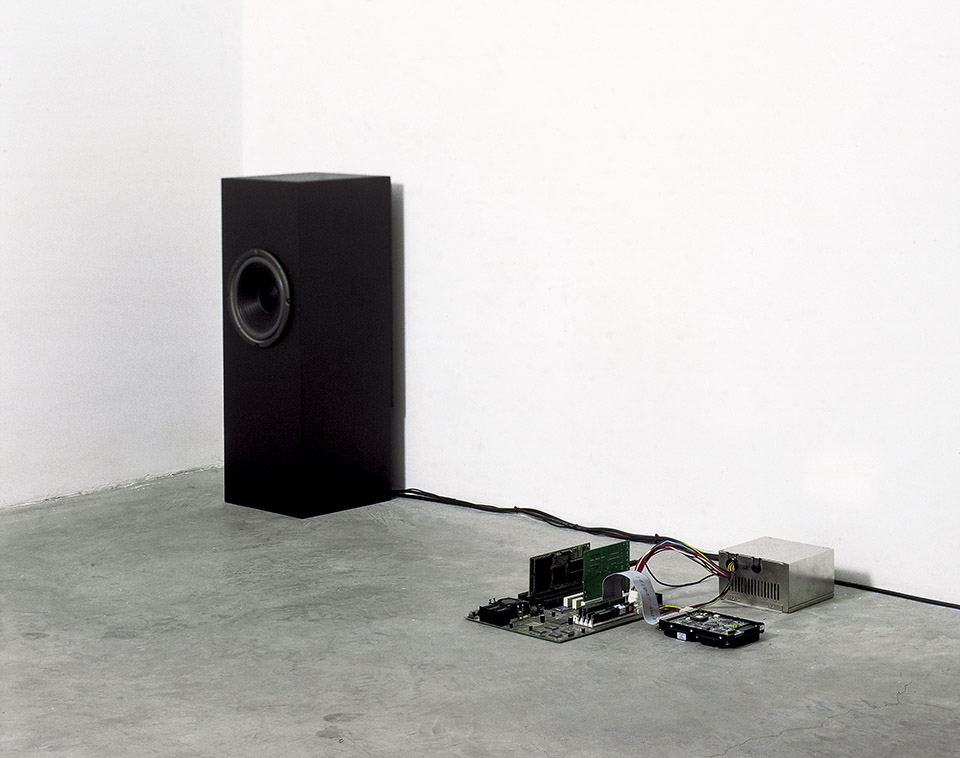
Bianco-Valente, Breathless, 2000, computer based installation
MDF: Right when new technologies were making giant strides, you turned toward other areas of research. Why?
B-V: When these technologies became fully available — after we ourselves had already been working on these themes twenty years earlier — we gradually lost interest in these practices.
We felt the need to focus our work more on relationships with people, and so we largely set aside the idea of work centered on technology, moving instead toward practices more closely tied to the human. No longer video installations or computer-based installations, then, but interventions less mediated by technological devices, leaving more room for the unpredictability of relationships between individuals.
MDF: An example?
B-V: The translation of an image into text, or of a text into an image, which we had wanted to carry out in the early 2000s using artificial intelligence, we later realized by involving people instead. The project dates from 2020, the year of Covid, and is called Il libro delle immagini (The Book of Images), published by Postmedia Books.
Over the three preceding years, we bought more than a hundred old family photographs at flea markets and bookshops in various cities, framed them all in the same format, and signed them on the back as if they were one of our own works. We then involved people in Italy and abroad who habitually work with writing or with images, giving each of them a photograph on the condition that they keep it on display in their home or studio and send us back a written description of the scene depicted in the photo.
The book is a collection of all these texts — there are 86 of them — and contains no images at all. The images referred to in the publication's title are the ones that form in readers' minds each time they begin reading one of these descriptions.
Of course, countless different mental images can form from the same text, depending on the reader's own experience. At the end of each text is the author's full name and the city where they live, so that if someone wants to compare their mental image with the real one, they can ask the person who wrote it for a meeting. Alongside the book, then, there is also a diffuse exhibition of these 86 photographs, which comes to life in the homes and studios of the people who adopted them.
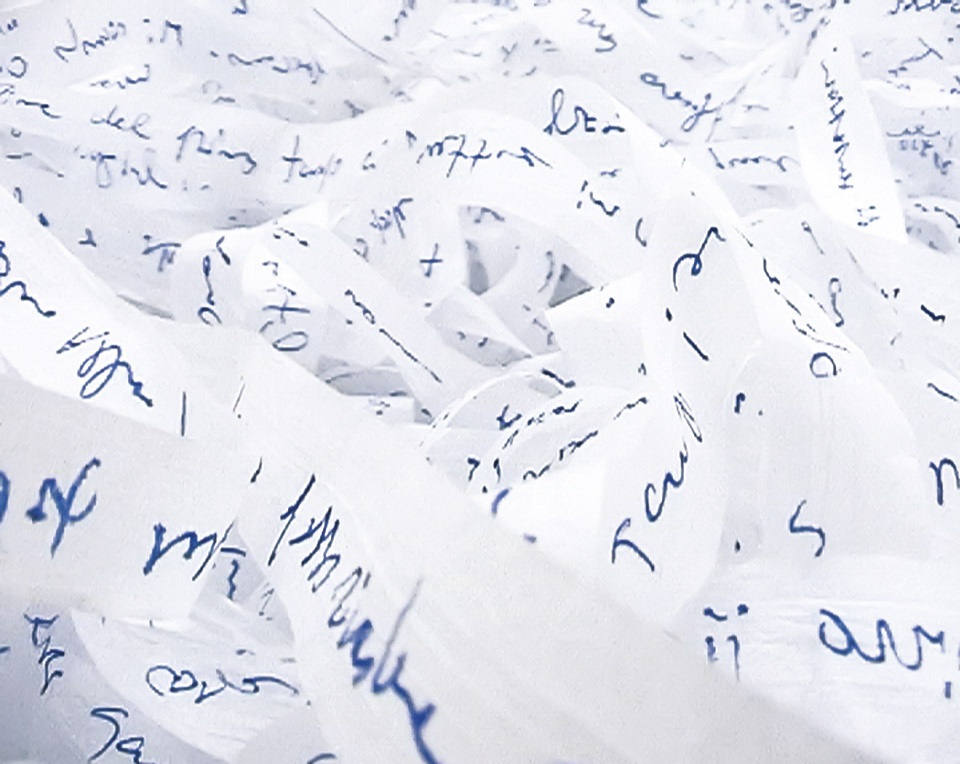
Bianco-Valente, Unità minima di senso (Minimal Unit of Meaning), 2002, ballpoint pen on paper, 1.5 km × 2 cm
MDF: We've talked about directions in your path, about deviations and even radical breaks. What, on the other hand, has never changed in your practice?
B-V: What has never left us is the feeling of constantly being one step from the precipice of boredom, of the already-said and the already-seen. To stay away from this danger, we accepted from the very beginning the idea that everything we did should be an experimental practice and never a final statement.
We have always tried to follow paths that seemed to us untrodden, even though we couldn't make out a clearly defined destination. In this practice we are not alone — we recognize the same tendency in the work of various other artists. It's about trying to imagine future trends and continually pushing forward the idea of the contemporary, which is also why dialogue between artists is essential.
Observing other people's work becomes part of one's own process and contributes to continually redefining this forward movement. That's how research works, both scientific and artistic — as a continuous movement of redefining limits.
MDF: And in your work of recent years, is it clear to you where to push that bar further?
B-V: This is perhaps one of the most significant elements of the work, and one of the questions an artist should never stop asking. There is obviously no single, clear, universal answer, since it's the entire ecosystem of world art that keeps fluctuating and resonating, more or less, with all the other forces at play in the world.
Just as happens in natural environments, in the art world too, trends emerge through intuition, trial and error — trends that may be more or less impactful, more or less lasting. What matters for an artist is to become aware that there is no final destination, and that, in carrying forward who we are and what we do, mistakes and failures are our daily bread.
_ _
Interview published in issue 6 of the magazine E.T.zine “Novantesimi,” May/August 2026.