Art, Networks, Places, Relations, Maria De Vivo in conversation with Bianco-Valente, 2015
There is no single human being, pure and simple, who is not intermingled with other human beings. [...] We are members one of another.
(Norman O. Brown, Love's Body, 1966)
Bianco-Valente began their life and work partnership in the mid-1990s. For both of them, the absence of an academic background gives their encounter a measure of unpredictable, happy autonomy that still characterises their presence on the Italian and international art scene today. Through different expressive means, Bianco-Valente first give form to the study of the body-mind duality and the relationship between natural and artificial, and then to their interest in science and technology, in literature and biological processes. Their works are the field of these connections, the conversion into image, the visual synthesis of these interactions with their strong "aesthetic appeal" (Sinigaglia 2015:7). In the conversation that took place at the close of the first day of the conference Reti performative (Naples, 15-16 January 2015), and subsequently in private, I asked the artists to share their ideas and views on some key concepts of the performative lexicon, since "process", "relation" and "interaction" are also foundational to their own inquiry. Watching and analysing some of their videos and some of their more recent site-specific installations brought out both the centrality of the concepts just mentioned and their interweaving with "word", "language", "city", "community" and, of course, "emotion", because if there is a constant running through a path so dense with openings and ramifications, I think it must be sought in the ability to combine the emotional sphere with the complexity of the themes and theoretical reflections explored from time to time. Indeed, there is no theory or scientific reference in Bianco-Valente's work that is ever used in a self-referential way.
Maria De Vivo: There are many ways, some very different from one another, to approach your work. I think, however, that one can only begin with Materia Prima, made in 1994, when you put a nail into Naples. Not conceived as a work at the time, Materia Prima went beyond the private space of a beginning - of your story together and your story as Bianco-Valente - and was exhibited in 2008.
Bianco-Valente: Materia Prima was made somewhat as a game, at a time when other artists were leaving Naples in search of greater visibility and attention. It symbolically sanctions our decision to stay in this city, in the place where we trained.
MDV: Naples is not, however, the city that has "imprisoned" you, but rather a kind of hub from which you've set off on numerous projects and numerous adventures. And, like a statement that is both programmatic and far-sighted, Materia Prima suggests that your work is made of maps, of crossings, of places and of relations with physical space and with the communities that inhabit it. Naples is the starting point of your story, but it has also become the place of your countless returns.
B-V: We made it to say "we're staying here", and we exhibited it once our having stayed could no longer be read as a form of resignation. We're aware of how complex it is to live in Naples, how much effort it demands, but every time we're away, every time we explore another city, we realise how important it is to us. It happens, in truth, even when we're here. It may be a cliché, but we feel a particular pull towards this city. It's this precarious balance, on the edge between order and chaos, that draws us in. A condition of enormous potential. All forms of life, in order to draw as much energy as possible from the outside, must organise themselves at a very high level of complexity, in an ever-unstable system that exists at the edge of chaos, as Waldrop (1996) has explained. Naples is like that.
MDV: Naples, in fact, accumulates and stratifies, so much so that the coexistence of different times is constantly before our eyes, and the relationship between the past - its force and its moods - and the present is very strong. It seems to me that the city is, for you, both stage and muse, matrix and landing place. I was very struck by something you told me a while back, in one of our first meetings ahead of the conference, about how your works come about - namely, not in the studio, but from the dialogue between the two of you as you walk through the city. A way of working that struck me at the time as very close to Situationist practices and to Guy Debord's concept of the "dérive", which called for crossing the city without a plan, without a destination or a schedule, choosing one's path not on the basis of what one knows but of what one sees around oneself.
B-V: When we begin a piece of work, we never start from a preconceived idea. The idea has to be born from thinking together, from discussion. That's what we normally do together, but it's also how we act when we're working in a group.
But the effort one must make, when reasoning about our work, is to start from an earlier point of view - we might dare to say a biological one. Before the superstructure tied to sociality, one must remember that the earliest communities were nomadic communities. Small groups moving across a territory in search of food. Later it came to seem more convenient to farm the land, to settle in one place, to build cities. And again, before imagining relation from a social point of view, one must consider that there already existed the great relation between the various living forms. Often what moves us lies there, something located at an even deeper, more ancestral level.
MDV: It seems to me that, in general, your works constantly put the past, and ancient knowledge, into communication with the future. And your very use of new technologies is always conceived in search of emotions. Even your strategies of mapping and "interrelation" travel, mobile in time and space, as if enacting a reinvention of memory, a revivification of it. There's an analysis of how the mind works at the centre of all this, and the reactivation and rediscovery of these ancestral emotions is its consequence.
In our first conversation, we reflected on the word "interaction". Working as a couple is already a good way of testing the complexity, the risks and the benefits of that process. A wager begun, first and foremost, by the two of you.
B-V: It all began with falling in love, with the desire to do things together. We had the same passions, and so we began to experiment. And it's been a continuous flow from the start. When our story began, the Bianco-Valente project was also born, and it's been an unbroken flow ever since.
MDV: Bianco-Valente is the fruit of your interaction. What value does the hyphen between your names have?
B-V: The hyphen denotes an identity that keeps each of us "visible", but it's also a trait d'union that links us and turns us into a single thing. We like our work to appear, from the outside, as belonging to a single entity. It isn't simple, but after so many years it's become almost natural.
MDV: I think this has been the most active and effective exercise in thinking through and shaping the relationship with others. Your work, the fruit of a negotiation, an exchange, a dialogue, is as if it had "formed" the relationship with others. Even if the outside world perceives you as "one", it's a "one" that always needs the other in order to exist.
B-V: We're so used to working this way that we would probably stop if left on our own. Before we met each other, we weren't artists; ultimately, this is the only way of working we know.
MDV: It's as if your form of interaction propagated outward. As if you yourselves were a mobile, temporary hub from which lines set off to cross paths with others.
B-V: We extend it to others - others too have things to say and to bring. We recently read a very interesting book we found ourselves reflected in, called The Extended Mind by Rupert Sheldrake. In this English biologist's reflections, the mind is not something confined only to the brain, only to the body. In the act of seeing, for instance, the mind steps outside the body and, through the generation of fields, comes into contact with the outside world. When we work in a group, a field begins to form, generated by shared reasoning: a field of interaction between minds. Out of this process, keywords emerge; they arise from a kind of background noise that can be deciphered. A "precise" wave within a sea that otherwise has an indistinct shape.
That's where the starting point for making the work lies.
MDV: It's no coincidence that both in Caterina Sinigaglia's recent volume (2015) and in Antonello Tolve's long interview (2011), the name of the scientist and psychologist Gregory Bateson comes up, with his studies collected in Mind and Nature. Bateson argues that the individual does not exist in itself but as the product of an interaction. It is within "constellations of interaction with other individuals" that the development of the self takes place, because "no man is 'resourceful', dependent, or 'fatalistic' in a vacuum. Any such characteristic is not really his but is rather a characteristic of what happens between him and something (or somebody) else" (1978:326). Keeping Bateson in mind, it seems to me that this systemic perspective gives the adjective "relational" a surplus of meaning that makes the sense the term took on in Nicolas Bourriaud's theory in the late 1990s - precisely when you were starting out - feel too narrow for interpreting your work. In your case the matrix is scientific, and it's worth noting that Bateson was, from as early as the late 1960s, one of the minds behind research into cybernetics.
If the Esthétique relationnelle was a very convenient label for framing artistic practices that would otherwise have lacked a theoretical-critical home, it would be reductive to imagine, as Claire Bishop - among the harshest and most persistent critics of Bourriaud - also says, that relational art is capable of covering every space.
We agree that the relational, as Bourriaud understands it, is in no way superimposable on your idea of relationality. Because it seems to me that in your case there's science, understood in a broad sense, to be taken into account, as well as psychology and cognitive aspects.
B-V: Since 2001, after studying in depth Ciro Discepolo's theory of "Targeted Solar Returns", we've undertaken intercontinental journeys towards destinations that are, more often than not, far from everything and everyone. In these places, chosen according to astronomical calculations and astral combinations, rather than giving rise to a work of a social kind through interviews or the gathering of documentary material, we began to question ourselves about the relationship between time and space and about the apparently invisible bonds that unite all things.
Even though there's no way to verify it, we've come to realise that it's possible to influence one's own destiny, improving it. This idea, little by little, gave rise to another - namely, that we are all "in relation", bound by a network. By setting off, one can alter the weave of this network, or bring certain things closer together while leaving others apart.
From here we began to reflect on the threads that bind us all, invisible to the eye but intuitable. If you think about coincidences, you can really imagine that there are threads binding us. So we make works that render these threads manifest, we represent them, as happens in the series of works titled Relational. They're threads whose existence we imagine so strongly that we want to make them manifest. But the discourse is twofold: on one hand we create works in which these threads are visible, on the other we create threads with the people we deal with or with the places we approach from time to time.
MDV: Let's go back for a moment to the keywords. Which ones represent you? The essential ones that manage to sum up your work?
B-V: "Word", and then "perception", "vision".
MDV: It's curious, but also very fascinating, that visual artists should think of "word".
B-V: Through the word we came to know each other, through the word we develop ideas, through the word we share projects with other people, we create relationships from which new works are born.
MDV: They're words that become images, tools for sharing, a way of undertaking and weaving "knowledge". Words, as you understand them, have a strong performative value, in the sense Austin gave the term in How to Do Things with Words - they produce/generate facts, "sharings", but do so in their creative and "exhibitionary" dimension. I'm thinking of Qui, lontano, a special project made for Arte Pollino in 2012.
B-V: For the Arte Pollino project, we thought of putting "into a network" the stories told by the inhabitants of the towns of Chiaromonte, Latronico, San Severino, Senise, Terranova, Viggianello about the neighbouring towns. The Pollino is a mountain range that divides Basilicata from Calabria. Spending time in Latronico, where Giovanna is originally from, we realised something that seemed trivial at first but became a matter for reflection: territorial proximity is not always a guarantee of direct contact. Since the roads in this area are winding, it becomes difficult to move easily from one town to another. So it happens that people don't know places that are only 30/40 km away. We thought, then, of putting these places into relation through the imagination of those who inhabit them.
How does a person imagine an "other" place they've never seen, or visited long ago, one they know only because they've heard about it, stories and tales, since their youth?
MDV: So you collected words, sentences, stories...
B-V: With the association's support, we set up a few meetings with people and essentially asked this one question: "have you ever been to town 'x'?" Some told us about their direct experiences, others, who had never been there, remembered things told to them by someone else. We recorded the conversations, gathered stories, some even moving, such as the journey some emigrants made towards Germany, stopping at Latronico to visit a biscuit shop, the biscuits then nibbled along the way. From these stories we decided to extract a few phrases. Essential phrases such as "at night the moon showed you the way", "a tree trunk outside the door as a promise", "a look and a handshake to seal a deal".
That's how the idea of a poster campaign came about. The emblematic phrases that described the territory, but above all the way people related to it, were printed on very simple posters with no specific reference on them. What struck us was that whenever we tried to get people to describe the architecture of these places, the interviewees would talk to us about people instead, as if almost everything else didn't matter.
MDV: As if the words gathered, the phrases shared, had become an element of relation between these different communities. Words that you posted up, that you put on display.
B-V: The poster campaign meant that, in each town, posters bearing the words of "others" were put up. Our idea was to build a new geography made of imagination and memory.
MDV: The way you work is already clear from this piece. You don't arrive with a finished piece of work like conquerors or occupiers, but let the work arise from the relationship with the people within the community. In your case, site-specificity is declined through time, memory, emotional geography.
B-V: What interests us is putting people into relation. If this happens through storytelling, that's very important.
MDV: It often happens that your journeys, your experiences, your relationships turn into narrative in images, and where you ask for words and put words into circulation, they're words that then become images - and by this I mean they're words that put themselves on display, visual syntheses of a work of sharing. Something similar happened in another territory, much further away: in Becharre, Lebanon.
B-V: Becharre lies along the ridge of a valley in a territory that is particularly hot from a geopolitical point of view. In 2013 we were invited by the association Front of Art for the project A Place For Action, curated by Katia Baraldi and Laure Keyrouz. We lived there for three weeks, guests of a Lebanese family belonging to a Maronite Christian community. In a territory of this kind, dealing daily with conflict given the pressures from the neighbouring countries of Syria and Israel, we decided to work on the theme of war, specifically on the fact that people tend to keep their own anguish hidden. What we wanted was to bring their thoughts, their fears and their desires to the surface, to make them manifest, sharing them.
We asked about the past and the future, and "what life can be like in this place". Among the many emotions gathered, an aversion to reinforced concrete emerged. On the "hated" concrete walls, phrases extracted from the many stories found a home. We transcribed phrases such as "we were like a laughing heart in the middle of the field"; "hope is in our hands".
We work a great deal on the word and on hands. Hands that carry out actions. If you think about it, the use of language and the use of hands sum up the two evolutionary steps that set us apart from other primates. We can shape the world, mould it with our hands and our words.
In Come il vento [Like the Wind] we reflected on the way humans spread across the earth, moving, carrying with them their own stories, their own ideas, their own language. It is "in the wind" that people meet, that stories and languages hybridise. For some of our projects we've used the title Come il vento: what they have in common is being "made" of the material of people's stories, which return to people. Ultimately, putting ideas and mental images back into circulation is something we like and care about a great deal.
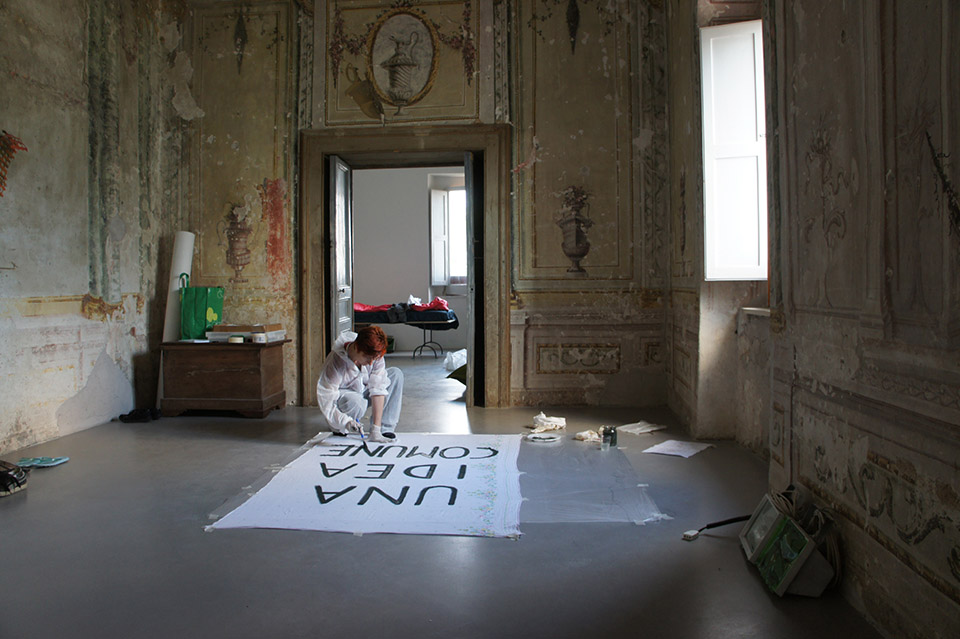
Bianco-Valente, Cosa Manca, 2014, project for Front of Art, Roccagloriosa (backstage).
MDV: In Roccagloriosa, on the other hand, a small town in the province of Salerno where you worked in 2014, again invited by "Front of Art", your attention turned to needs: "What's missing?", you asked.
B-V: The answers we received to a question that is, after all, essential in its simplicity, once noted down in our notebook, found a place on old tablecloths and sheets that we asked the people involved to donate to us.
Copied out onto these objects with their strong symbolic value, given the weight of sharing and intimacy they carry with them, the answers were put back into circulation, so that each thought could give life, voice and form to other people's needs.
MDV: In this project, as in others, you become a means for "organising interaction", a tool for offering people another perspective, another way of living together.
The dialectical nature of public space is a theme particularly investigated in the most recent art and criticism. For Common Spaces in 2014, the final exhibition of the Whitney Museum's Independent Study Program in New York, invited by Maria Teresa Annarumma, you presented the third version of Costellazione di me [Constellation of Me].

Bianco-Valente, Costellazione di me (Constellation of me), 2014, backstage ISP Whitney Museum/The Kitchen, NYC.
B-V: We worked on site, specifically in Chelsea, which today is one of the most elegant neighbourhoods in New York, with a very high density of galleries and luxury boutiques. Up until 35-40 years ago, Chelsea was a port and industrial district, before undergoing a process of gentrification. To explore the changes in this neighbourhood, we organised workshops with elderly residents who had always lived there, in what we might call "public housing" - the Fulton Houses, with their regulated rents.
These same people were invited to write out, in their own hand, their stories and their relationship with those places - including ones that no longer exist - on the walls of The Kitchen gallery, which hosted the final exhibition.
In the exhibition space, the key points they had identified on the map were transposed onto the walls. Starting from those nodes, traces of their individual experiences, lines of words were drawn, intersecting to occupy two corner walls of the gallery.
MDV: Space, time, memory returned, redrawn by the words of a new constellation, because Bianco-Valente's atlas is an "atlas of emotions" that shows us that places are made by the people who inhabit them, by their history and by their perception of the territory. There's a very strong narrative aspect in this work, as in others.
B-V: Today we like to think that a trace of this approach was already present in our earliest works. Altered State from 2001, for instance, is a work made entirely of words from the diaries of the scientist Albert Hofmann, who discovered LSD. Also in Unità Minima di Senso [Minimum Unit of Meaning] from 2002, on a thin paper ribbon a kilometre and a half long, writing "translated" the images and memories that most shaped our personal history. Paradoxically, in those years we almost proudly maintained that our works had nothing to do with narrative. They weren't videos with linear stories, and they had no defined temporal structure; there were no actors playing a part. There was something deeper, tied to interiority, to the subconscious.
MDV: These traces have re-emerged, karst-like, in another guise, so much so that one could say that Bianco-Valente have, over the years, remained faithful to an underlying idea while still continuing to experiment.
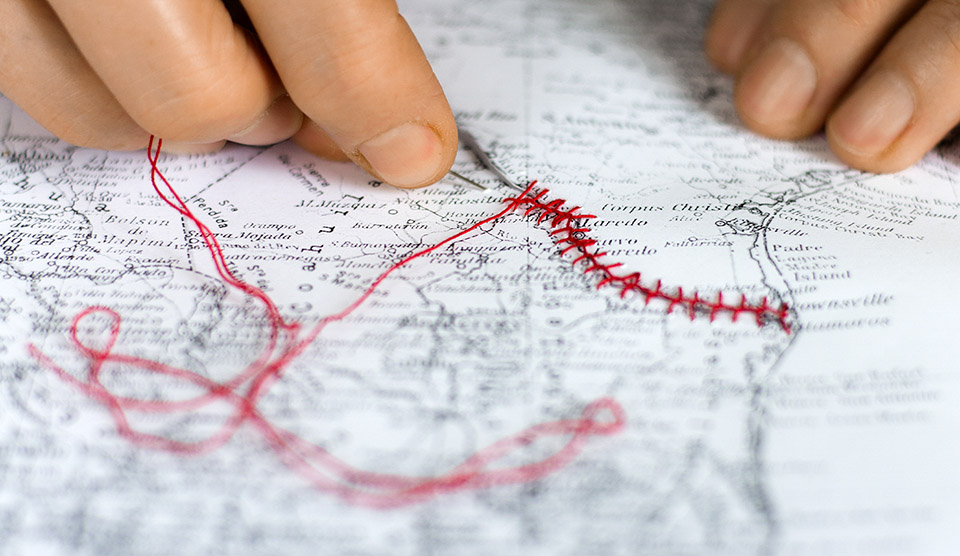
Bianco-Valente, Illimite, 2014, Video, 2'49'', music by Andrea Gabriele.
Our conversation ended with the viewing of Illimite, a 2014 video accompanied by music by Andrea Gabriele. For some time now, Bianco-Valente have played, to borrow a phrase from Walter Benjamin's Berlin Chronicle, at articulating the space of life into a map. Threads and seams run through the maps of significant places, because maps, as is well established within an artistic tradition that includes Alighiero Boetti, On Kawara and Jan Dibbets, to name only a few, "are not solely instruments of topographic measurement" (Pignatti 2011:8) but much else besides. They are the space of encounter and relation, the space of exchange and change, onto which one can project life and renegotiate boundaries, frontiers. If a map performs a quantitative, qualitative, selective reduction of what it seeks to represent, if a map serves to name places, to describe them, to "possess" them and to orient, Bianco-Valente do not run the risk of "producing a reductive idea of the map, placed entirely at the service of power" (Bruno 2006:188). Theirs is a "tender" mapping1, the fruit of a collective work that carries inscribed, on several levels, the deep meaning of "relation" and an idea of a world in constant motion, constantly to be redrawn.
1 The adjective is used in the specific sense given to it by Giuliana Bruno, referring to Madame de Scudéry and her Carte de Tendre of 1654, whose description opens the volume Atlas of Emotions.
Bibliographical references
- Bateson Gregory, 1978, Steps to an Ecology of Mind, Milan, Adelphi (Italian edition).
- Bruno Giuliana, 2006, Atlas of Emotions, Milan, Bruno Mondadori.
- Pignatti Lorenza, ed., 2011, Mind the Map, Milan, Postmedia Books.
- Sinigaglia Caterina, 2015, Il libro delle parole, Milan, Postmedia Books.
- Tolve Antonello, 2011, Geografia delle emozioni, Fisciano, MMMAC.
- Waldrop Morris Mitchell, 1996 (1993), Complexity: The Emerging Science at the Edge of Order and Chaos, Turin, Instar Libri (Italian edition).
_
Taken from Reti performative, letteratura, arte, teatro, nuovi media, edited by C. M. Laudando, Tangram Edizioni Scientifiche, Trento, 2015