
Lorenzo Madaro, Studio Visit with Bianco-Valente, 7 January 2024
In Chiara Pirozzi's previous studio visit with the duo, what struck me was less what emerged about their relational art in the traditional sense, and more the shaping of a true "Bianco-Valente method" — something that isn't about aestheticizing but is profound, gradual, radical. That is precisely why their commitment, militant and political in a sense that is also poetic, always deserves careful, attentive observation.
For this reason I believe their practice is entirely autonomous, by now codified through more than twenty years of sustained work that has drawn them ever deeper into a process of relation rooted in different contexts — both metropolitan, through permanent, site-specific interventions such as Nessuno escluso in Naples since 2020, and within small communities, through projects that have given rise to installations and collective actions that remain part of the lived experience of those who took part. More than concerning themselves with cultural contexts and the art system in its traditional sense — even though exhibitions and publications are, of course, also part of Bianco-Valente's professional commitment — what matters to this deeply sensitive artist duo (partners in art and in life, whose understanding surfaces almost physically whenever one hears them speak together) is contact with contexts, with citizens, especially those who have no connection whatsoever to contemporary art and its spheres.
The duo works by exploring the relationship between forms of life, contexts, and the boundaries of communities' emotional intimacy, in relation to specific places and their histories. Their projects often develop in close contact with their first audience: the citizens themselves. Bianco-Valente's method calls for long sessions of verbal exchange, capable of generating stories, presences, and tangible testimonies of a long journey — that of encounter, of an art capable of giving rise, above all, to a relationship. This is the case with Cosa manca (2014), in Roccagloriosa, one of the clearest examples of their working method, but above all of a result tied to the search for a latent, hidden emotionality — that of a "minor" Italy seeking to express itself, which, thanks to the two artists' commitment, succeeded in doing so. Solitude, bitterness, visions, intimacy: these are the cardinal points of a public confession that gradually unfolded across the town's balconies. As the artists themselves describe it, they first asked the same question to different residents of Roccagloriosa, met on the street or in their homes — What is missing? — an apparently banal question that nonetheless left people at a loss, many of whom asked, before answering, whether it referred to the individual or to the community; over several days they painted the answers onto sheets and tablecloths, then asked residents to display them on the day of the opening, arranging things so that each person showed on their own balcony the answer given by someone else, weaving together, in an uncontrollable way, the community's points of view on its desires and needs — a response that was enthusiastic and that, for one day, changed the streets of the town and the way its residents interacted, offering many prompts for reflection and discussion.
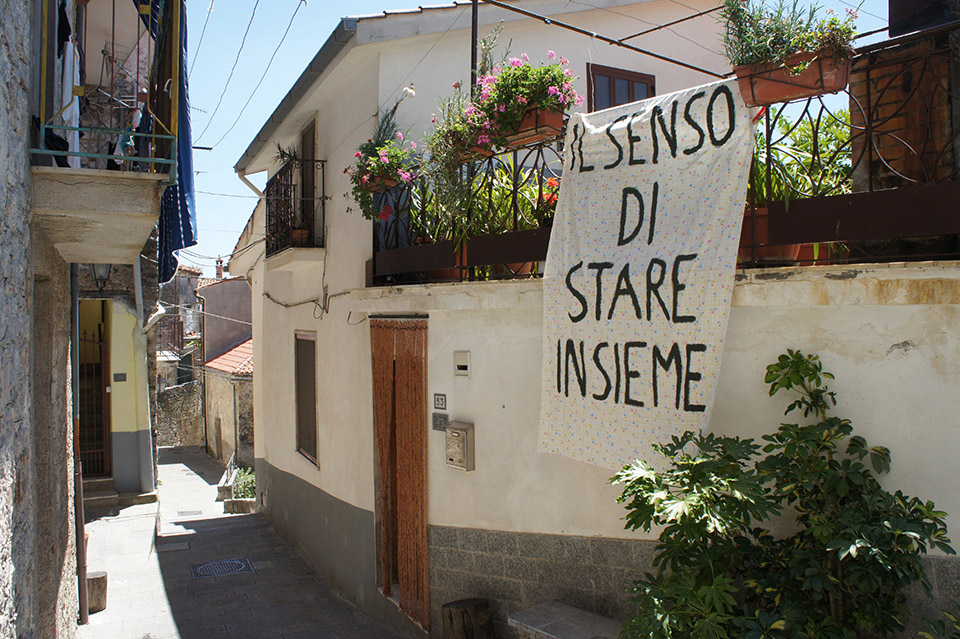
Bianco-Valente, Cosa Manca, 2014, project for Front of Art, Roccagloriosa.
Among the duo's works that are by now distant in time yet still resonant and damnably relevant is certainly Illimite, a video from 2014, in which the gaze is focused on a geographic map, cut up and stitched back together with red cotton thread. A hand slowly sews together different sections of paper, reassembling the geographic borders of the world's hot spots — territories in conflict with one another, where the contrasts have by now become macroscopic and belong to contemporary History. The thread thus reassembles the borders between Mexico and the United States and between several African or Middle Eastern countries, ideally putting into dialogue places dense with inequality, tragedy, and political and cultural precarity. Art thus takes on the task of building community, of opening theoretical reflection on issues concerning world geopolitics. The soundtrack, conceived by Andrea Gabriele — drawing on voice recordings made in various extreme areas of the globe — contributes to this with real intensity.
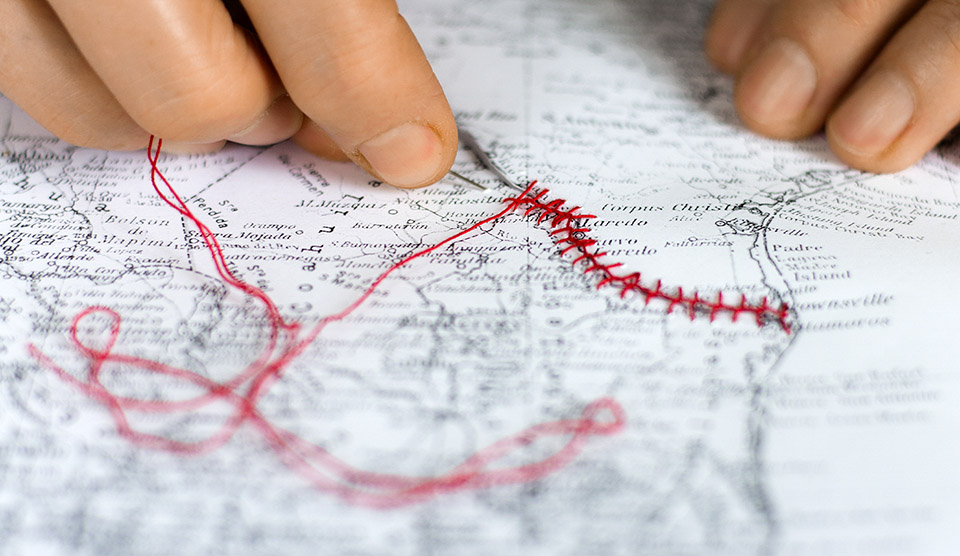
Bianco-Valente, Illimite, 2014, Video, 2'49", Music by Andrea Gabriele.
Bianco-Valente's work is a daily practice that follows several different branches. Both are currently deeply engaged in teaching at Italian Academies of Fine Arts — and I am convinced their contribution will be fundamental to the internal reflection of a great many of their students, since one of their first merits is a profound empathy toward those they engage with — while the project conceived in Latronico, in Lucania, with Pasquale Campanella, A Cielo Aperto, continues without interruption, involving artists from different backgrounds every year and inviting them to spend a period of residency in the small town, which by now has become, to all effects, a diffuse museum. L'amore è nell'aria, a work from last year, clearly illustrates the constants of the duo's commitment. Invited to San Marcello Pistoiese for the Dynamo Camp project, the artists brought together a group of parents of children with disabilities who deal daily with school and healthcare bureaucracy and a thousand other pointless stresses. All of them were invited to engage with a large block of marble armed with hammers; to release energy, they struck the block according to their own strength and inclinations — a block that, in its new form, holds, as the two artists suggest, the memory of their own gestures and emotions.

Bianco-Valente, Love Is in the Air, 2022. Project for Dynamo Camp, San Marcello Pistoiese.
I struggle to identify weak points in a body of work capable of reinventing itself, time and again, within the contexts in which it operates, within the mental and physical spaces in which it takes shape. I hope their work can achieve the strong international recognition it deserves, which would also be an opportunity not to remain anchored to an Italian geography — even though their path has already taken them to the United States and elsewhere, if on relatively rare occasions — since remaining so anchored could, in the long run, become a weakness. This is not in order to pad out their curriculum in the strict sense, which is naturally already solid, but in order to engage with ever-different relational methodologies, adapting them each time to contexts far removed from the Italian anthropological and social ones.
Text published on the Rome Quadriennale website, in the “Panorama” section.