Loredana Troise, Nessuno Escluso, Interview with Bianco-Valente, 2020
Loredana Troise How did the work Nessuno Escluso (No One Excluded) come about? What mental directives guided the realization of your project?
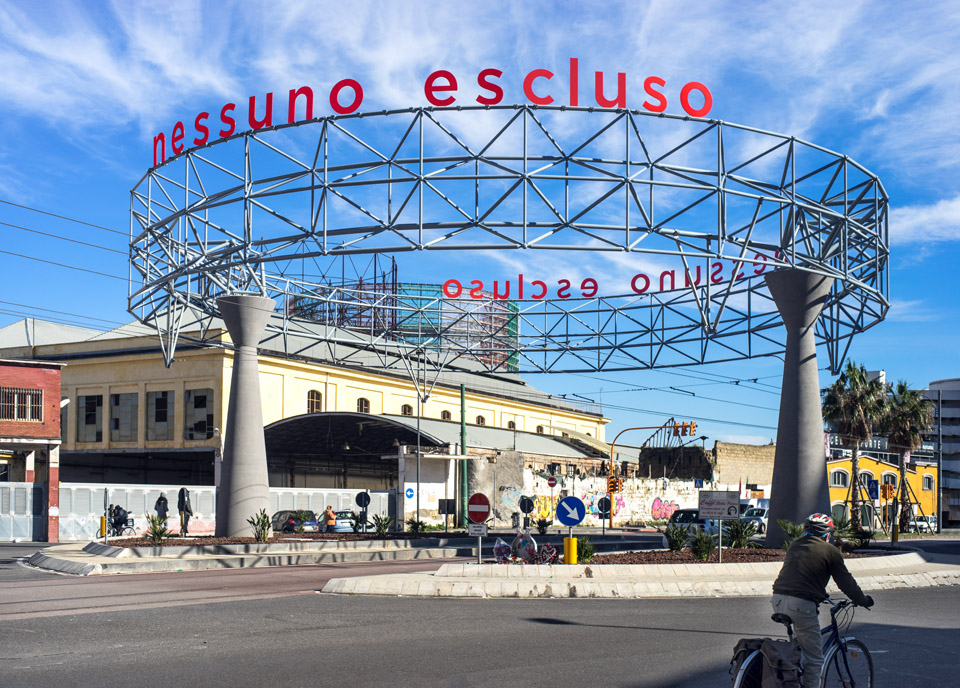
Bianco-Valente Pasolini, Umberto Eco, and several other intellectuals have recognized in the city of Naples the ability not to conform to global trends, or at least not to passively submit to them. This territory is a powerful generator of imagery that, feeding on utopian visions, asynchronicity, and dissipation, manages to generate avant-garde movements in music, theater, cinema, literature, art, and so on. This is possible thanks to a series of historical, urban, and above all social conditions that characterize the city. However, a radical transformation is currently underway, due to the commodification of the city for tourism purposes and the consequent gentrification process that is unraveling the threads of the intricate social fabric that has animated its streets for centuries. Looking ahead, all of this will make Naples a victim of its own stereotypes, progressively dismantling its capacity to generate visions that do not conform to the norm, in the arts and in culture. For us, Nessuno escluso means safeguarding the possibility for the less well-off classes to continue living in the city center; it means investing as a priority in education so that everyone has the opportunity to develop themselves as fully as possible; it also means keeping alive the capacity to welcome other cultures, to transform and be transformed — a distinctive trait that has characterized this place since its founding by Greek colonists 2,500 years ago.
L.T. There are places that, though marginal and lacking a soul, can be transformed into mental, artistic places: Nessuno Escluso is proof of this. Is this a correct way to describe your work?
B-V The entire coastal axis of Via Marina is an emblematic area of the city; it speaks volumes about how detrimental a whole series of strategic choices made over the last hundred and fifty years have been. This street tells us of a sea and a landscape denied, a history and architecture distorted, without the people who live in these places having received anything in return — quite the opposite. Most people don't perceive any of this, because they travel this street by car without ever truly setting foot on it, without any real desire to understand this drama. Obviously, our work doesn't directly solve any of these problems; rather, it is an invitation to adopt an alternative point of view on this area of the city, to become aware of its tragically unexpressed beauty.
L.T. How did you engage with the area where you installed the work? What were the critical issues?
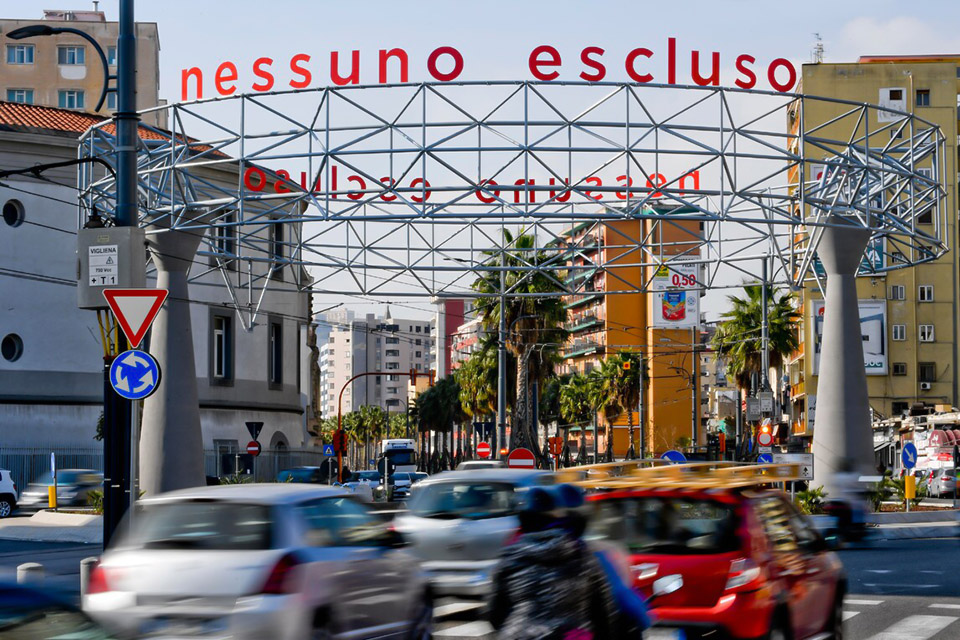
B-V There is an ongoing media war over the redevelopment works on Via Marina, also in view of the upcoming municipal elections. For years, the bone of contention seems to have been the large circular structure recalling the two old gasometers still visible in the area. In the original project, it was meant to support a series of illuminated advertising panels, which were never installed for traffic-related reasons. We were asked to intervene precisely on this structure, and we conceived the work by integrating it with the intention of transforming it into an ideal gateway to the city. And then all hell broke loose: the inauguration of Nessuno escluso became an occasion to reignite controversy and stir up public opinion against alleged waste of public funds and against our work itself. In a short time, on social media, we became the target of invective from people distressed by the serious economic problems generated by the pandemic. The local press could have played a role in clarifying certain issues, but so far it has limited itself to writing about it as a news item or a matter of political debate, without ever truly considering the work as such.
L.T. Your work often puts into dialogue dimensions that are apparently very distant from one another, if not opposite: the center and the periphery, the museum and the forgotten place, the external landscape and the mental one. What are the ethical guidelines through which you manage to address these delicate dichotomies?
B-V We are passionate about the idea of art that is freely accessible to people, without entry barriers, without gatekeeping — works conceived expressly for that place, to relate to that specific community, yet still able to embody a universal meaning. No simplification or self-indulgence, but rather an invitation to look at the context from another perspective, to break, even just for a few moments, the rhythm of days that all seem to unfold and then vanish in the same way. At this stage of our lives we feel we want to go in this direction, sometimes making mistakes, trying again, in order to fail better the next time, as Beckett suggested.
L.T. Nessuno Escluso is the product of a reflection on today's scenarios: do you think that everything today has become less instinctive and more calculated?
B-V Artists have always managed to express themselves in both ways; it largely depends on the personality of the creator and on the moment. Our interventions very often arise in relation to a specific situation and are closely connected to the history of a place, its architecture, and the individuals who inhabit it. Even though from time to time we decide to use different media, the work is always an expression of this relationship and can arise from a suggestion or be the very synthesis of people's feelings.
L.T. How much does the word "recovery" (central to your poetics) inform this work, and what meaning do you attribute to it?
B-V In the mind, a phenomenon occurs whereby memories of the past are continuously reworked and integrated with new experiences of the present. It is this continuous intermingling of old and new experiences that determines our personality. The past that interests us is the one that remains alive in people's spirits, that which, integrating with the present, is still able to generate visions and impulses directed toward the future.