
Leandro Pisano, Relational Aesthetics, between Image and Sound: Bianco-Valente, 2013
Making visible the infinity of invisible bonds between events and people, through an aesthetic investigation that hybridises technology and nature, physical and virtual places, body and mind, rational and humanising elements. Along this ridge has developed, in recent years, the research of Giovanna Bianco and Pino Valente, active for two decades on the contemporary art scene closest to new media. Relational networks that join people and places, from which emerge glimpses, details, peripheral visions that compose synoptic pictures arising from unexpected perspectives, in a reading that keeps revealing new levels beyond the cartographic surface (the geographic category and the map are two key elements of this research process), in a multiplication of planes that becomes a "syntactic vertigo", to use an expression Helga Marsala applied to the two artists' work.
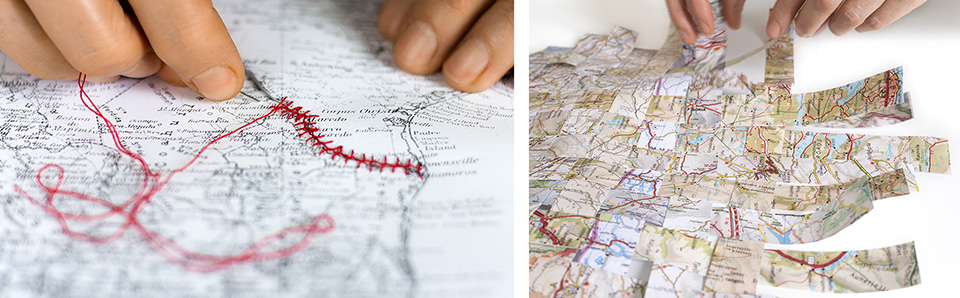
"A detail we don't often reveal," Giovanna and Pino state, "is that the starting structure of these relational networks is born by connecting the geographic coordinates of certain particular travel destinations that we've been reaching every year now since 2001, to test on ourselves a theory that predicts hypothetical astral influences on human beings. A series of installations we made with electroluminescent cables were the premise for creating works in which we put people and their stories into relation, weaving them together into a single work".
For Bianco and Valente, travel represents an experience that unfolds across different perceptual and bodily levels, in territories where the artists can become "antennas" capable of capturing and reflecting landscapes, events, but also connections and suggestions tied to the experience of places. Exactly as in the case of "Frequenza fondamentale", a permanent installation inaugurated only a few months ago in the park of Villa Mascolo in Portici, a stone's throw from Naples, the place where the duo has lived and worked since the early 1990s.
"When a few years ago the Municipality of Portici, in the Vesuvius area, decided to launch a competition to install permanent works of art in architectural spaces due to be renovated, we decided to take part with a project inside the spaces of Villa Mascolo, an eighteenth-century residence where a scientific multimedia museum was being set up.
The space was particularly fascinating, precisely because a green area within a city as heavily urbanised as Portici lent itself to a stimulating experiment.
The idea of a competition didn't particularly appeal to us, but the curator Eugenio Viola, who was at the time in charge of the project room at the MADRE Museum in Naples, insisted a great deal and convinced us to submit a project of our own. The idea started from a work we were dealing with at exactly that time, namely a sound installation focused on the concept of wind, which used sensors measuring wind force in various places we had physically visited over the years, processed and transmitted using a web server: the result was a series of sounds generated by measuring these winds blowing in different directions. The competition brief called for the use of new media and reference to certain historical, naturalistic, archaeological and landscape themes: the Bourbons, Vesuvius, the sea, the archaeological sites of Pompeii and Herculaneum. Starting from these references, we thought of the presence, on Vesuvius, of a series of sensors monitoring volcanic activity, installed by the Vesuvius Observatory not only on the volcano but also in the towns and in the Campi Flegrei area.
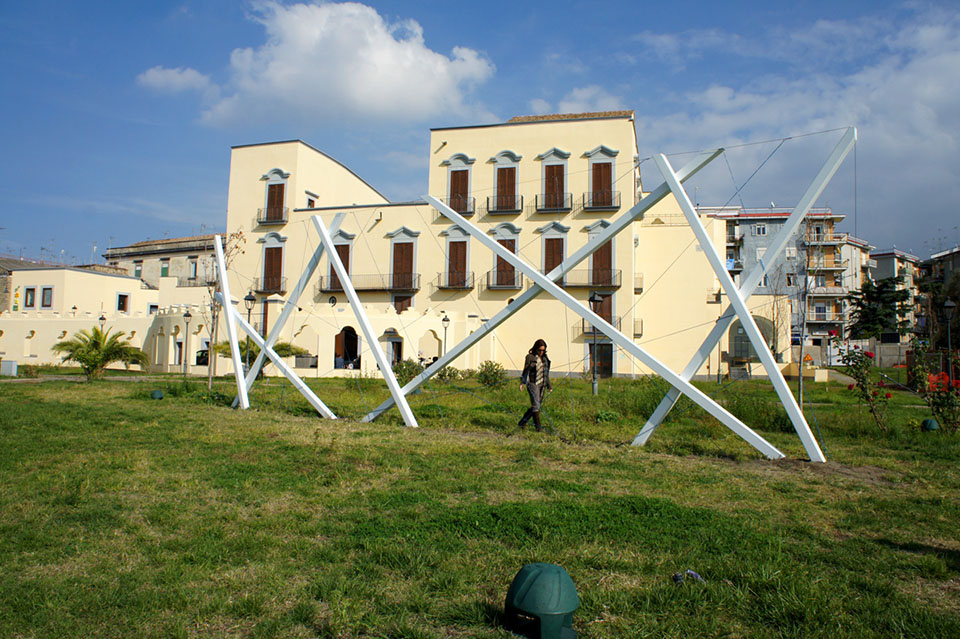
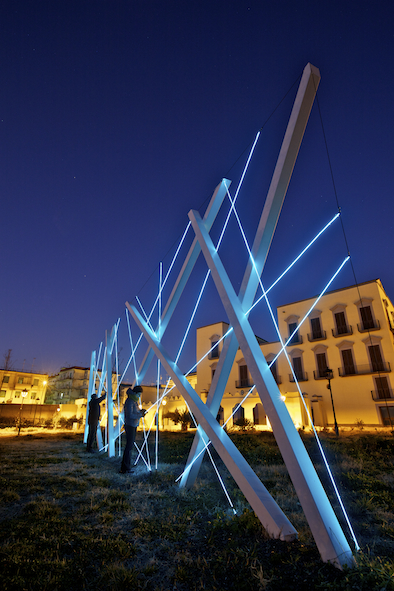
Essentially, it was a matter of translating the idea underlying the wind installation into this new project, into which new, significant elements tied to the territory came into play, linking it to the real-time data coming from the Vesuvius Observatory. It occurred to us to involve an electronic musician in the project, who would produce a series of sounds mixed and transmitted by a server in a random way. The sound-processing parameters (speed, frequency, and so on) were then modified whenever the data measured by the sensors varied, completely changing the sound scenario generated by the system. So one could move from a very faint, rarefied soundscape to sudden variations, in the same way that sudden gusts of wind break the silence and calm of quiet scenes. On a visual level, we decided to work on the concept of a relational network, building a steel structure that supports a series of electroluminescent cables. The luminosity characteristics of this network, in its fibres and nodes, are also directly linked to the output given by the server in reprocessing the sensor data, but with a much slower response than that of the sounds, and thus with a greater latency time than the signals coming from the Vesuvius Observatory.
The network itself becomes the representation of this relationship between Vesuvius, which is the element that has, in a way, generated the entire morphology of the area, and the spectators present at Villa Mascolo who experience the installation. There's an imaginary line between this network, which sits at that point almost like an antenna receiving the volcano's signals within the urban area, and the cone of Vesuvius itself. The title 'Frequenza fondamentale' [Fundamental Frequency] refers to the fact that the city itself lives in this condition of vibration, also reproduced in the low frequencies of the oscillations measured by the sensors, which fall within a range of 6 to 50 Hz: it's as if the fundamental frequency of the city of Naples, bounded to the south by the Vesuvius area and to the north by the Campi Flegrei, were represented precisely by these seismic noises, from which all the other sounds that make up the landscape then arise.
The changes in Vesuvius' state are perceived, through the sounds, within the villa's park, joining natural levels and technology: putting into relation the volcano, whose crater can be seen from the park, with what you can hear inside the park itself, in the least invasive way possible - which is, after all, one of the central concepts of our work. In our other installations too, we always start from the idea that interaction with the environment must absolutely be grounded in principles of naturalness: respect for the place one works in comes through having a low impact on it. Interacting with places without denaturing them is somewhat the idea we try to express, one that also emerges in 'Frequenza fondamentale'." As on few other occasions in the past, sound here represents not an accessory component but the true sensory vector of the relational experience between man, territory, nature and volcano. This work on sound was crafted by the late Mario Masullo, aka Mass, with whom the Naples-based duo also had the chance to collaborate on other occasions, above all "Self Organizing Structures", a CD/DVD published in 2004 by DSP Recordings.
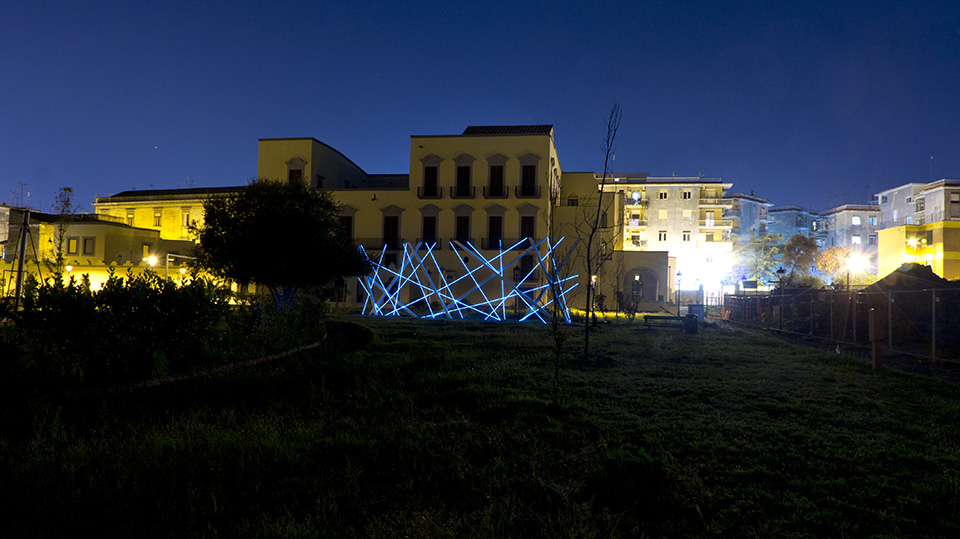
"After the very first design phase of the work, we then set about involving a series of friends, artists and contacts, precisely because we wanted many people to take part in building the installation. For the production of the sounds, we chose Mario Masullo, to whom we were bound by a deep friendship and with whom we had collaborated several times in the past, while Roberto Pugliese worked on the software for the interaction between the signals and the sounds generated by Mario. The initial idea was to add sound to the villa's entrance avenue, but discussing it with Mario we then decided to avoid a soundscape flattened into stereo two-dimensionality, trying instead to follow a circular path traced by the layout of the secondary walkways, with the possibility of working in surround sound. As for the speakers, we chose garden speakers with a very sturdy structure, single-driver, with a polycarbonate housing topped by 22'' cones set into the ground.
As for music and sound, we've already had important collaborative experiences in the past, from 24 Grana to TU M', from Mou, Lips! to Pirandelo, often with the important presence of Andrea Gabriele, up to Mario Masullo/Mass. This time, however, the relational level was certainly more complex: we defined a basic idea on which other figures were called on to discuss and intervene at different times. As for building the structure, for example, we relied on the collaboration of Ferdinando D'Ambrosio and Lia Chiaiese of Alef progetti. But many other figures were also involved in the project. 'Frequenza fondamentale', ultimately, is the result of the interaction between us and everyone who took part in the project".
Reference resources:
- https://www.bianco-valente.com/
- Helga Marsala, "In Calvino's footsteps. Bianco-Valente's invisible maps", in AA.VV., "Alfabeto Esteso", Venice 2008
- Gigiotto Del Vecchio, "Bianco-Valente, between Newton and Descartes", in AA.VV., "Bianco-Valente, Meu mundo è hoje", Rome 2007.
- Bruno Di Marino, "Bianco-Valente, art as science-fiction", in AA.VV., "Bianco-Valente, Meu mundo è hoje", Rome 2007.
_
Article published in issue 180 (May 2013) of Blow-Up, in the column Inframedia/Culture del suono visivo by Leandro Pisano