
Gaetano Centrone - Bianco-Valente, When Art Becomes a Public Matter, 2019
In an era when artists often work in pairs (there are numerous examples in our country) an exemplary partnership in this sense is represented by Bianco-Valente, who are, in civil records, Giovanna Bianco (Latronico, 1962) and Pino Valente (Naples, 1967). Based in Naples (undoubtedly one of the most vibrant cities in terms of current artistic research) they have been active since 1994.
The dimension in which they work is that of public art, outside the confined spaces reserved for professionals in the field, inspired by a strong ethical, social, and political component in its best sense.
They recently inaugurated Relational, a dense and important site-specific work on the facade of the Italian Cultural Institute in Stockholm, which will be on view until February 10, 2019. We reached them for an interview.

G.C. How did Relational come about? What is its design concept? Since it's a site-specific installation already realized on other buildings, how does it change each time it is reconfigured for a new space?
B-V Relational originates from the video installation Relational Domain from 2005, centered on the relationship between people, events, and places. We consider this work the first fruit of our project on journeys and astral influences, based on a theory from the 1970s by Ciro Discepolo, which we began in 2001 and which is still ongoing. In 2009 we were commissioned to create a public artwork for the city of Potenza, and we decided to work on the facade of the library, a rationalist building in the very center of the city that had remained abandoned since the 1980 earthquake. We believe that architectural/urban development is closely tied to the social fabric of a place, and that every change in public space inevitably has repercussions on social life, and vice versa. So why had the residents of Potenza removed the presence of this building to the point of no longer even perceiving it, despite passing right by it daily on foot and by car? What we intended to do was to reinsert into the city's social and architectural relationships this building that had been excluded from them, and we decided to do so by drawing a symbolic network of relationships on its facade.
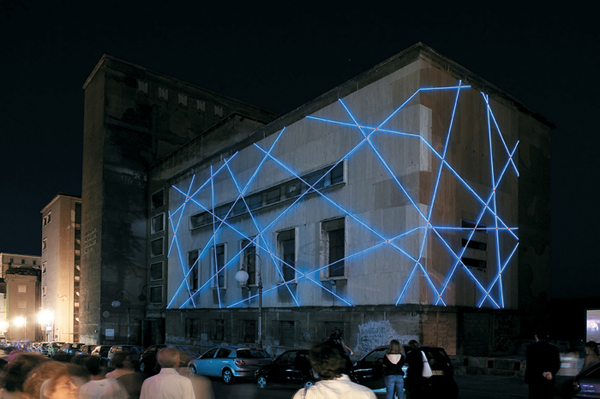
It worked, so much so that several articles were published that gave momentum to the restoration work. Since then, we have been asked many other times to realize this work again, but we have only accepted on occasions when the proposed building had, in its DNA, a strong connotation of exchange and relationship with the surrounding social context. Naturally, the design of the constellation changes each time in relation to the architectural characteristics of the building.
G.C. For those of us who closely follow the work of the Italian Cultural Institutes around the world, this is very happy news: rarely do the visual arts find space within this network, and especially with new interventions. How did this fortunate occasion come about?
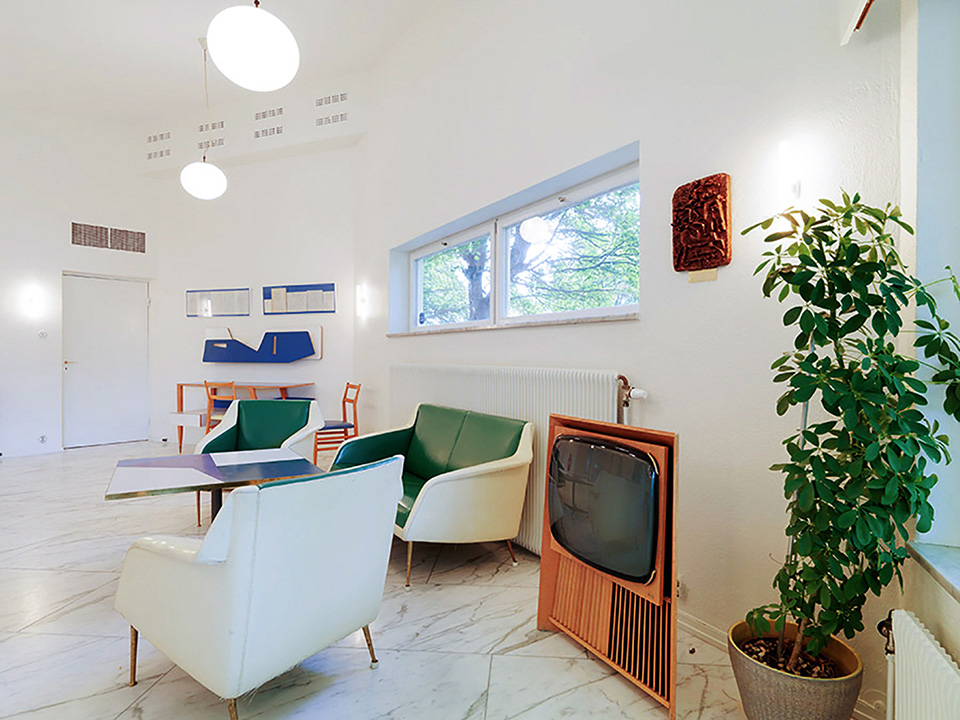
B-V Maria Sica has been the director of the Italian Cultural Institute in Stockholm for only a few months, and she immediately set out to highlight the importance of the building that houses it. Designed by Gio Ponti in the late 1950s, it was a futuristic achievement for its time and still today retains all the original furnishings designed by the great Milanese architect, which create a bright and engaging atmosphere. The Institute, established through the patronage of Maurilio Lerici, was inaugurated exactly 60 years ago, and the director wanted to give great prominence to these celebrations by dedicating an entire evening to Gio Ponti. Furthermore, wanting to underscore the very purpose for which this Institute was founded — namely, to foster relationships and cultural exchange between Italy and Sweden — she commissioned us to create the work Relational, curated by Adriana Rispoli. As one can imagine, it was very moving for us to have the opportunity to interact with such significant architecture, and we can say we are very satisfied with the result.
G.C. You are certainly among the most active artists in the field of public art. Was this a deliberate choice, or a slow evolution that inexorably pushed you onto this terrain?
B-V We like the idea that art should not remain confined to a narrow circle of professionals, but that it should engage in dialogue and confrontation even with people who would not normally frequent a gallery or a museum. This conviction has grown stronger since about twelve years ago, when we launched, together with Pasquale Campanella, the A Cielo Aperto project in Latronico, through which we invite other artists to get to know the area and to develop a work of public art or a workshop that activates a relationship with the social context, the history, and/or the natural landscape of the town. A Cielo Aperto is an important life school that continues to show us how the relationship between art and people can be both harsh and full of poetry.
G.C. You were among the protagonists of a collateral event at the latest edition of the traveling biennial Manifesta, in a wonderful Palermo. What do you think of the event? It seems to us that you were fully in the spirit of the event — do you agree?
B-V We believe it was a fortunate occasion for exchange between the city of Palermo and Manifesta, which was able to make use of exhibition spaces of poignant beauty, set within social contexts full of "real" life, not sanitized for exclusive tourist use. The chosen theme, The Planetary Garden. Cultivating Coexistence, was also extremely interesting, but many of the invited artists presented works focused on disengagement or on mere news items, which were not even able to fully exploit the beauty of the exhibition spaces — spaces that, on several occasions, ended up overshadowing the works themselves.
On the other hand, one only needs to take a walk through the Ballarò market to understand how the city is light years ahead on issues such as intercultural dialogue and integration, and has little to learn from events of this kind. There were, of course, exceptions that alone repaid the effort required to reach the various exhibition venues. Terra di me, the exhibition we presented at Palazzo Branciforte, had a gestation period of about a year and a half, during which we developed various reflections on how the perception of the Mediterranean Sea has changed — from the classical era, when it enabled the birth and spread of Western culture, to the present day, in which many people imagine the sea in between as a barrier they would like to see as impassable, thereby denying its very nature.