Daria Filardo in conversation with Bianco-Valente, 2016
Daria Filardo:
There is an immense universe in which to imagine one's own position, and there is a fairly large earth, given our human scale, to travel across. Your work moves, just as you do.
In the large exhibition space of the Tenuta dello Scompiglio, with 'Frequenza Fondamentale' you brought in the solar system, creating a system that is both cosmic and intimate, where each of us searches for the visual and sonic frequency that, in that moment, moves us. You move and you lose yourself, and you enter another space, an utterly dilated space that none of us can really imagine. I got lost and found myself again in it many times over.
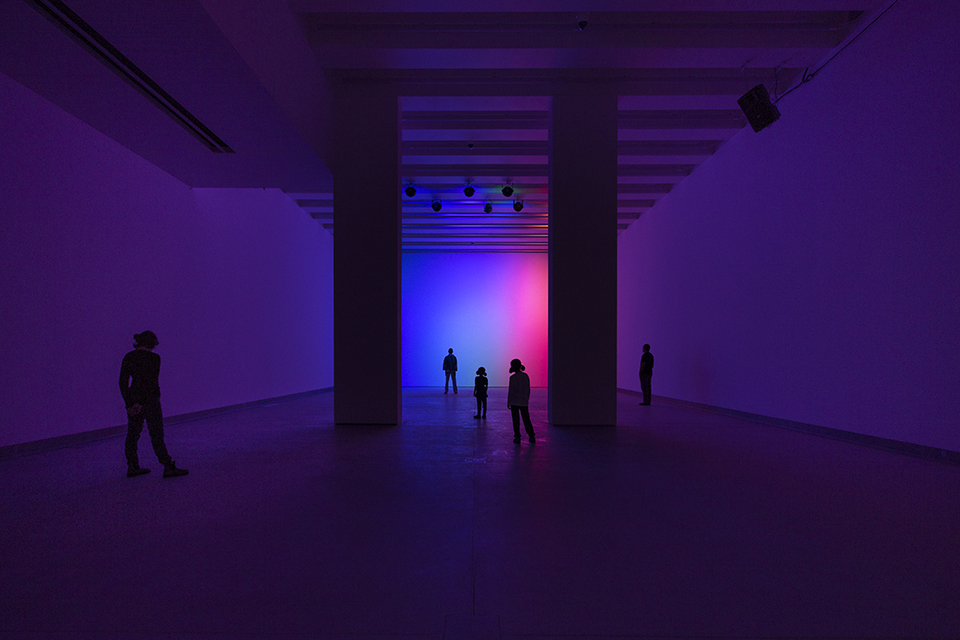
Bianco-Valente, Frequenza fondamentale, 2015, Tenuta dello Scompiglio, 9-channel sound and light installation, environmental dimensions, photo by G. Mencari
And yet I know that your work walks on the earth, that you constantly seek relationships and connections, and that it all happens through the process of building with others, a process that leads to a form that is your own and at the same time shared with others - but in your own life you also pay very close attention to the precise, calculated position of stars and planets, to the idea that nothing happens by chance and that chance itself moves within an oriented and complex space of given relationships.
There is a part of your life that I consider the perfect counterpart to this cosmic work, and which you don't consider a proper work to be shown in art spaces, but which is a founding part of who you are, of how you mark time and of your way of entering into relationship.
Twice a year, on the occasion of your birthdays, you set off for places indicated by complicated calculations. The journey is sometimes simple, sometimes very complicated, and has no precise purpose other than being in that place at that moment, and staying there a while.
It's a practice, a constant, a very intimate moment in which you seek out and explore a position on earth, just as you asked us to find our own within the universal installation at the Tenuta dello Scompiglio.
In 'Frequenza Fondamentale' there are no recognisable images, only lights, abstract colour, sounds, hisses, noises; on earth, on the other hand, everything is full of images of people and things, and you have an enormous archive of photographs taken and experiences accumulated.
Can you tell me about these journeys of yours?
Bianco Valente: In 2001 we read a book that described the possibility of influencing one's own destiny by reaching a specific place on the globe on the occasion of one's own birthday.
It was a disruptive read for our way of seeing things, which up to that point had been fairly rational and tied to the "scientific" thinking that had also characterised our artistic research.
The vision proposed by Ciro Discepolo in this book of his, tied to astrology and astronomy, had roots going back to the earliest human civilisations, all of which paid great attention to the movements of the stars in the sky, attempting to connect them to the various events, large and small, that happened to individuals.
It was a completely irrational, unverifiable idea: the possibility that the planets of the solar system might have some kind of energetic or symbolic influence, capable of affecting the destiny of living beings.
This theory fascinated us so much that it pushed us to test it on ourselves, and the greatest benefit we've gained from it is certainly having become aware of the importance of symbolic combinations, and having learned to recognise the right moment to do things and to deeply know our own strengths and weaknesses.
DF: The images in your vast archive and the images of the 'Frequenza Fondamentale' installation seem worlds apart, but I believe they're complementary and speak of an incessant, constantly moving need for mapping, one that encompasses two apparent opposites - rule and chance, given relationships and relationships that simply happen - two opposites that seem fixed but that actually exchange places, oscillating and reversing their positions.
On your travels your (photographic) eyes record details, and the images you capture, as photography almost always does, tell us many stories. Your journeys are an earthly movement, but they are also a mirror of a larger system, invisible to the naked eye. This invisibility of detail is the hallmark of the installation at Scompiglio, where your body (and ours), taken over entirely by sound that gets inside you and colours that fill your eyes and your field of vision, becomes an integral part of an organism larger than us, impossible to perceive all at once. There, the total counterpoint to the detail experienced on earth takes place.
The two poles are therefore two moving maps, two movements in space, two searches for a position that is never definitive but that makes movement its very centre.
How important is it for you to trace these maps? What always drives you to set off? What do you find, and what are you looking for?
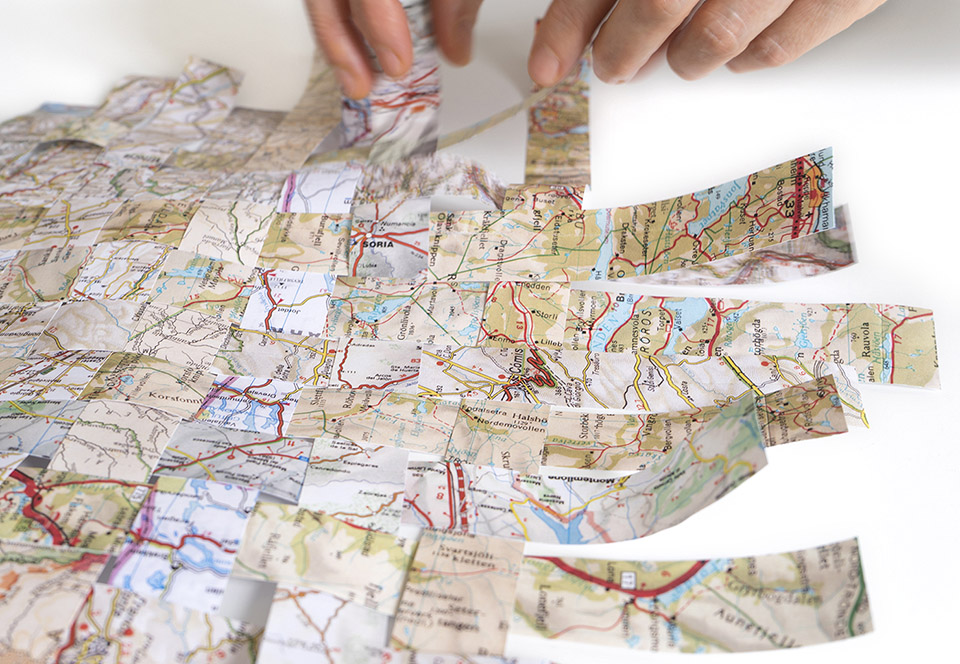
Bianco-Valente, Tu sei qui, 2012 - 2014
B-V: What makes these travel experiences so fascinating is that everything moves to make three different planes intersect in a particular way that we choose in advance.
Obviously the first is the temporal plane, because this appointment happens only once a year for each living being, at the exact moment of one's own astronomical birthday. Then there's the plane represented by cartography, which we use to decide exactly which place to reach (and sometimes, in the absence of means of transport, we've had to cover the last stretch of two or three kilometres on foot, even at unlikely hours, and that too is an adventure within the adventure). The third is the real reason we travel, and it's the symbolic (or energetic) combination expressed by the position occupied, at that precise moment and in that particular place, by the bodies of the solar system in the sky.
There are so many variables at play that it's hard to say exactly what we're looking for; what is certain is that, whatever it is, it can't be verified.
When preparing for the first trip in 2001, we firmly decided that these journeys would never become a work in themselves: no footage to be edited into a video, no "social"-themed interviews with the inhabitants of one of the last Inuit communities in the far north of Canada, or of the 400 people who live on Saint Paul Island in the middle of the Bering Sea, and so on. If anything, these journeys would change us as people, and by changing us the work would in turn change - which is exactly what happened four years later, in 2005, with the work Relational Domain, which for us marks a watershed between before and after.
So there are no filters between us and the people we form relationships with; there's only the fascination of exchanging, for a few days, experiences that seem utterly different but are, at bottom, essentially shared in their basic humanity - whatever the latitude.
That's how our interest was born, both in cartography and in the works in which we modify geographic or nautical maps to add new layers of reading, and in the bonds that continue to hold people and social groups together. Threads we're unable to see but whose existence we can very well sense. These threads, made of stories, experiences, imagination, relationships of love or hate - threads that appear very thin because they're almost imperceptible, yet have the power to heavily shape (for better or worse) our entire existence - we make visible in many different ways in our installations, whether intimate or monumental.
DF:
I'd like to keep talking a little more about the counterpoint between the abstraction proposed in 'Frequenza Fondamentale' and the photographic realism of your travel archive, about how these two poles are two complementary representations of your need for a relationship full of lived experience, and at the same time full of a void to be filled - a void made of colours and sounds that doesn't need 'figurative' images because it is an experience of space, of movement, of the urgency to feel part of a larger system that can't be broken down into photographic fragments.
Your archive of travel images isn't a work; its transposition into 'Frequenza Fondamentale' became the cancellation of all your photographs into a pure blending of colours, and at the same time an extension of your experience to all of us, invited into the space to find our own movement within the solar system. Can you tell me more about this duality between the image and the abstraction you're proposing?
B-V:
There are various levels of communication that can put us in relation with others: obviously there's the word, the image, and then there are the more or less unconscious symbols, body language, and the various forms of energy that can be activated to establish contact.
Frequenza fondamentale is exactly this. Having established a space of intervention, we wanted to saturate it with colours and sounds, in constant mutation, that echo the motion of the planets of the solar system across the sky - a motion to which humankind has always attributed a scenario of symbols and a spectrum of energies capable of spreading its influence to everything that is alive and moves on earth.
Frequenza fondamentale is, in a way, an invitation to become aware of the energies that shift and keep passing through us from the moment of our birth, to keep orienting ourselves in space in order to choose our own position and enter into resonance with whatever makes us feel well.
DF:
You've spoken of the importance of symbolic combinations and of the importance of knowing how to seize the right moment to do things and of knowing one's own weaknesses. Ultimately, this awareness suggested to you by the experience you have each year on your two journeys, guided by the position of the planets, becomes a practice, an exercise for staying vigilant, attentive, listening to the world, the places and the people around you. Travelling twice a year constantly reminds you of all this and keeps you open to the works you're continually developing; it's as if you had two fixed points (even if very much in motion), your journeys, and this allows you to keep moving as you encounter others - is that right? Your journeys become an intimate ritual, a constant that allows your research to remain open.
B-V: That's exactly right; over time we've learned to pay closer attention to events and encounters that in the past we would have called mere coincidences. It seems to us more and more clearly that randomness for its own sake doesn't really exist, and that whatever gesture you make in this world will ripple out in a chain, through space and time, into other events, more or less significant.
Ours, however, isn't a mechanistic view of the principle of cause and effect, since all events, people and places are in constant transformation, and we have no fixed points from which to determine the actual weight of things. We can only go along with the flow, try to enter into resonance with the energies that pass through us, and influence the unfolding of events, insofar as we're allowed to, moment by moment.
_
Taken from the catalogue of the exhibition "I Can Reach You", curated by Daria Filardo, Pietro Gaglianò, Angel Moya Garcia, Tenuta dello Scompiglio, Lucca 2015-2016