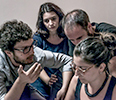
Aste & Nodi in conversation with Bianco-Valente, 2016
Aste & Nodi: This is a question we would have liked to ask you. Joking aside, we're not just architects and urban planners but also sociologists, art-history experts, designers... The first thing we understood in working together was the need to go beyond the boundaries of our individual specializations — not to be multidisciplinary or interdisciplinary but, as we like to define ourselves, undisciplined. Setting boundaries aside and working on the points where they meet. It has never happened that a piece of work was really shaped by any one person's academic background. We like to think we're taking up a challenge of our time, experimenting with our own path.
In an age when the boundless expansion of produced knowledge is often matched by an ever more fragmented segmentation and specialization of knowledge, we try, somewhat against the current, to bring our knowledge together, to draw from different fields and not stay within enclosures but instead navigate the enormous sea of information, aware that it will be impossible for us to know it all, but excited to face the next wave. The results are cross-disciplinary projects, hard to label, with blurred boundaries and plenty of room for further exploration.
Of course, art, as both an approach and a technique, is something we've found ourselves handling on several occasions. Probably because it's a competence that belongs to none of us in particular, and so it lends itself as a level playing field for experimentation. But perhaps art allows us, in some cases, not to have to give explanations, not to have to provide scientific proof of the accuracy of our forecasts, statistical data, exact measurements. Working with art has allowed us to work with indeterminacy, with inexactness, with feelings and intuition; it has allowed us, in such an unstable era, to play with the cards we have and try to have our say.
B-V: Another particularity we share is that we often operate in small communities in the inland areas of our country, places that, since the 1960s, seem destined for an inevitable emptying-out. What drives you to work in these areas?
A&N: For us, small towns and inland areas have represented, from the very start, an interesting field of study, because while on one hand our cities are becoming increasingly saturated and we have to face urban-scale issues that speak to us of density and new ways of living, on the other hand, as one can easily imagine, small towns and peripheral territories are emptying out. For economic reasons, the services offered to residents grow weaker; the numbers no longer allow public transport systems, cultural offerings and other activities to be maintained as they were in the past, when substantial public funding and different population figures allowed for a certain way of life. Starting from this analysis, small towns have represented an ideal laboratory for us, in which to experiment but above all in which to learn. To learn from the sharing practices that characterize certain rural economies and that are very often carried over to a larger scale — just think, for example, of self-production and food self-sufficiency, issues discussed on a global scale that in rural areas are common practice. Working in small towns means, on one hand, learning from local collective knowledge, grafting on new knowledge and new skills, and on the other, addressing contemporary urban issues from a different point of view.
B-V: The distinctive feature of the Vincenzo De Luca Association is that it doesn't request any public funding for its activities; in fact, all the works and workshops of A Cielo Aperto have been produced solely with funds raised from members' annual dues. The continuity of this budget, even though it's not comparable to that of large-scale productions, has allowed us every year to invite one or two artists for this project, which we co-curate with Pasquale Campanella. The reason the Association doesn't want to use public money is to avoid political dependency or sporadic disbursements of funds that could interrupt the project's continuity. What do you think — would you base a long-term project of yours solely on public funding?
A&N: In our experience we have worked on and carried out projects at different scales, from self-financed or low-budget projects with private or public investment, up to projects with major public funding; we can say we have worked, and worked hard, on projects with budgets close to zero as well as up to a million euros. The issue of funding cannot be trivialized, nor perhaps generalized — every project has its own story, and in certain territories, for instance, for large-scale actions, public funding is essential. Perhaps one of the problems we can identify in the way large projects are financed is that the administrative and bureaucratic process required to carry them out drains a great deal of energy, perhaps too much. For this reason we're convinced that the system of public funding, when directed at groups, associations, cooperatives working with innovative practices in the territories, should be based on trust and on the project's results, granting greater autonomy in financial management. Rethinking funding instruments and the regulations that govern them is a fundamental step if administrators want to invest in the innovation of peripheral territories. A model needs to be found that safeguards the quality of projects and guarantees proper spending, while at the same time giving those carrying them out greater freedom of movement.
B-V: Commenting on the events we attend or whose reviews we read in magazines, especially when we try to weigh the works in an exhibition against what we read in the press release, we often use (and improperly so) the verb "to shift." We ask ourselves, "What has this artist really 'shifted,' after all?" Or, to pay a compliment, we say, "That artist has really 'shifted' things!"
For us the term "to shift" means doing something that permanently changes, even if only slightly, other people's perception of art. A bit like in the long jump, when an athlete for the first time surpasses a previous record and from that moment on everyone has to measure themselves against the new world standard — except that in art there are no units of measurement that apply to everyone, and everything is always fascinatingly uncertain.
Coming back to our conversation, what do you think we have "shifted" with our respective projects developed in Latronico and in the other communities where you have worked — assuming we have really "shifted" anything?
A&N: "Shifting" is a good word for "change" — its strong physical connotation, the change of place it implies, captures very well the variables anyone dealing with urban and, more broadly, territorial processes has to work with.
Ultimately, our approach has always been very much oriented toward what already exists; toward trying to identify the potential and opportunities of the contexts we've worked in, interpreting our role as that of "facilitators" who try to recombine the cards on the table, to "shift" the factors at play in some way in order to create a new narrative or trigger new processes.
Over these now eight years of fieldwork, we can say we have shifted some things, some decidedly material, others less so.
- We have shifted people
Our goal, in addressing the issue of depopulation in our country's inland areas, has never been to bring back those who had left, or to make those thinking of leaving choose to stay instead. So we didn't want to reverse the flows, but to create new ones. With the summer workshop "Bring your ideas on vacation," for example, we tried to create an occasion that would bring new (albeit temporary) residents to Cilento — young, highly educated people, largely similar to those who had chosen to leave. About three hundred and fifty students over six years have spent part of their summer imagining possible development scenarios for a small inland town in Cilento. With nomicosecittà, to give another example, we "shifted" hundreds of walkers around the city, giving them the chance to look at their own city from unusual points of view, and also, a little, to change it, creating unexpected geographies and connections.
- We have shifted the bar (upward)
Dealing with what already exists, as we said before, and creating opportunities. Not just opportunities to be seized by others — with our projects we have always tried to make ourselves a reason for the territories we found ourselves working in to see themselves anew, from a different point of view. The narrative of a place, in fact, has a decisive influence on the possibilities for regeneration that place is able to seize. In various contexts we have interpreted our role as that of "agents" who, through their action, try to trigger processes of redefining the collective vision and thus also the possibilities the context itself is able to pursue. Porta Capuana, in Naples, is one of these — a place where initiatives and projects promoted by different actors have been born and continue to be born, and where we can say we helped "light the fuse" of change.
We ourselves have shifted too; we keep progressively changing our approach based on the experiences and the mistakes we make, and — certainly — we would have liked to shift more people and more bars (upward), along with everything else we weren't able to "put in other places."
At this point, though, we'd like to ask you some questions.
For example, we've noticed that your projects have a great territorial impact. You often work with people, interacting with small communities in a "low-intensity" dialogue made of constant, unassuming communication. Often it seems that the work-as-product takes a back seat from a formal point of view, favoring, as the outcome, the change produced between the parties involved. This is a point in common we see with our own work, with the difference that we find it much harder to communicate. Will you tell us your secret?
B-V: We don't believe there are any real secrets, and it's true that communication requires a great deal of energy and attention — above all, you have to document well what you do; that's where everything starts.
The other elements to keep very much in mind are continuity, basic sincerity, and non-pathological, non-obsessive use of social media and mailing lists. Interpersonal relationships are also very important, and exactly the same rules apply to them, in particular being sincere, always.
A&N: In our work the dimension of "impact assessment" is very important; above all, we're required to be able to show that what we do is capable of producing some kind of expected change. From artistic practice, by contrast, this is not expected — at least not explicitly. Almost as if it were something more "ephemeral." Where do you look for the change you want to produce (if you want to produce one)? And how do you "assess" it?
Can you teach us how to make others understand the value of this kind of work?
B-V: The main change happens inside people, and it takes place at the level of awareness, particularly for young people and very young people. And let's be honest, there are no methods for measuring these changes, which are hidden within people's psyche and behavior, quickly and with anything like a scientific readout of the data.
Over the long term, though, the change is visible — very much so. We can give you the example of Come il vento [Like the Wind], developed in Bsharri, Lebanon, in 2013, where almost all of the young people involved in the project later chose a field of study related to art and architecture. Recently, some of them had to explain why they were applying to take part in an artistic residency in Italy, and they emphasized how formative their involvement in the Bsharri project had been. The same goes for A Cielo Aperto, where the distinguishing feature is the changed awareness of the people involved in the various artists' interventions; we notice that those who took part in the workshops or collaborated with the artists have lost the typical reverence for contemporary art and the obsession with wanting to "understand" the work at all costs — indeed, after so many years and so many different experiences, they have come to understand quite well the mechanisms an artist can bring into play to create an environmental work or a performance. Obviously all of this also has an effect on social life, with more and more people developing a propensity for participation and sharing.
Consider that in Latronico none of the works installed outdoors has ever suffered an act of vandalism — there must be a reason for that, don't you think?
A&N: Your works are often exhibited in public space, or in any case in a way that highlights their connection with the city. Is this a choice that depends on your idea of art's accessibility, or is there something else behind it?
B-V: It's true, compared to the past we now create many more works of environmental art, whose conception develops each time in relation to the history, the landscape and/or the community of the place where we're invited to intervene. Exhibiting in public space is more rewarding for us because it gives us the chance to engage with a much wider audience than the one that usually frequents museums and galleries, and also because our wish is to move beyond the self-referentiality and conformity that often afflict those environments. The A Cielo Aperto project, too, which since 2009 has brought various artists into relation with the territory and its inhabitants, is based on the idea that people can interact daily, and without any filter, with the works installed at various points around the town.