
Arianna Ladogana, Lines of Meaning, 2023
«Most life forms have the ability to perceive external reality through the sense of sight, but we are the only species to possess such a complex and articulate form of language. Man is fully aware of this specificity and has in fact always attributed a thaumaturgic power to the word, capable of healing, but also of inducing the formation of images and "scenes" in the minds of our interlocutors. Recent studies seem to show that the human brain evolved by placing great importance on the information obtainable from listening to other people's experiences, and this would have determined the success of stories and the instinctive need we all have to hear them told.»
A constant presence in the work of Bianco-Valente, the word is the elementary particle of a broader system of emotional and physical engagement between people: storytelling.
Walking through the streets, listening to sounds and noises, meeting people and chatting with them, working empathetically in contact with people, observing the details of a place and grasping the sensations it emanates, reflecting on works outdoors in front of a landscape. These are just some of the project phases in Bianco-Valente's work, in which the word is always the protagonist.
Before meeting, Giovanna and Pino had never created art. Giovanna Bianco, originally from Basilicata, studied film history in Naples; Pino Valente, from Naples, studied geology. There had always been in them an interest in art, in exhibitions and museums to visit; however, their meeting, which took place at the end of 1993, united them in the production of art and, right from the start, stimulated them into an energetic and foundational experimentation. Thus the duo Bianco-Valente was born. Sharing a passion for cinema and science and seizing the possibilities offered by technological means, their first research was oriented toward video and experimental filming, in which scenes recorded with Giovanna's video camera (the same one used for her degree thesis) were overlaid with words and images concealing important reflections. What fascinates them is the human being in his relationship between mind and body and in his relationship with the outside world and with his fellow humans; all realities conceived at the cerebral level through particular perceptual mechanisms.
The study of biology allowed them to understand how interaction occurs between life forms, how these have evolved over time, how they perceive the external world and how they retain memory of the experiences they have had. Man is the most evolved living being; during his progress he separated from his ape companions through an unprecedented and more complex use of the hand, which allowed him to perceive the world around him differently and, in a sense, to shape it.
What further differentiates him from other species is the ability to communicate through the word by means of an articulate linguistic faculty. The reflection that Bianco-Valente invite us to make concerns the importance of the word; indeed, through stories, images are created in the minds that listen, and through language thoughts are articulated and emotions are expressed. The human brain has evolved so as to absorb concepts from the outside in the form of words: through reading, listening to stories and tales, or watching a film, we can learn new things without making mistakes, we can have experiences without living them in the first person, we can feel pleasure and be stimulated by the discovery of "how it ends," and, as happens with children, we can gently fall asleep. We are dependent on stories.
Extending this reflection to the community, the artists maintain that it is precisely the possibility of telling ourselves stories and sharing experiences that holds a community together, forming its identity and its memory; when we speak of a "social fabric," we are referring precisely to this principle of interweaving, which weaves together, thread by thread, the everyday life of each person.
To formalize these studies and reflections into works of art, the image of the hand recurs very often in Bianco-Valente's works, alongside the written word and weaving.
An example of this is the video Sulla pelle [On the Skin] (2010), in which words drawn from travel diaries, letters, essays and novels, formulated by intellectuals and writers in different eras about the city of Naples, are visually layered.
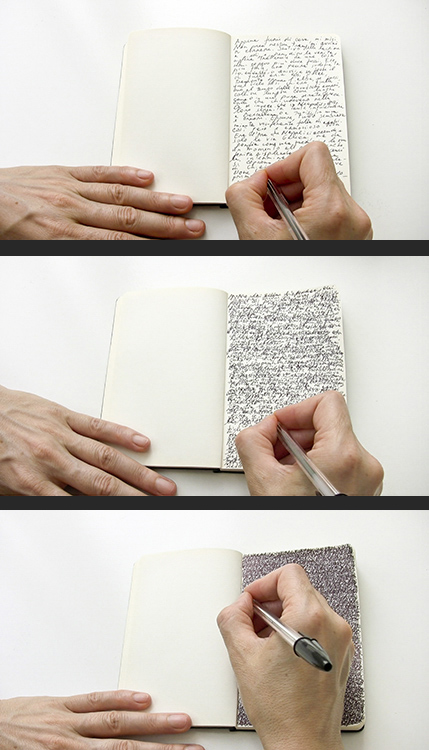
Bianco-Valente, Sulla Pelle, 2010, Video 4’18”, Musica di Andrea Gabriele
Used on multiple levels, the word is for Giovanna and Pino first and foremost the possibility of exchanging ideas and comparing views in order to organize their work as an artistic duo (like two minds and four arms) in an activity always carried forward through a fruitful and continuous dialogue. They deal mostly with public art, which, overcoming the self-referentiality and sterility that sometimes pervades spaces devoted to art, is designed for public space, reflecting on space in a continuous relationship with history, with the landscape and with the people who, living in the place in question, consequently host and experience the artistic intervention.
The invitation is always aimed at reflecting on a theme, and they very often find themselves working in a given place with a group of people; it is in cases like this that the dialogue extends to everyone. Whether it is workshops in contact with students who share a knowledge of or interest in art, or projects shared with young artists, or again in contact with a community of people not at all involved in the artistic context, the first project phase is to form a group, all together.
Bianco-Valente's goal is to bring the project to life together with the group, which is why they choose not to bring with them to the place of residence a defined idea to be formalized. They recount how the beginning is never easy to manage. It happens that one experiences a general sense of disorientation, or tries to win, through a process of acquaintance, the trust of people who are initially somewhat doubtful, in order to convey values of sincerity and respect typical of their way of working. After this first moment, and once trust has been won, the group work is highly stimulating and productive; people show themselves to be like rivers in flood, they are excited to feel part of a process that concerns them as human beings and want to share ideas; this is the beauty and power of public art, which can cross social boundaries and deeply strike even those who, going about their everyday lives, encounter it on the street during their daily passage.
But then, public space is not only physical, walkable space, it is also the space of stories; it is by this principle that public art can also be something ephemeral, powerful, like a moment intensely lived by people who, keeping it forever in their memory, will tell it again and again, during everyday conversation, to remember experiences and to hand down to future generations the intimacy of that place.
In Bianco-Valente's work we also find the word as handwriting, understood as an intimate expression of one's own mind and body, and also as an object, that is, as an image or a filter that, overlaid onto a landscape, alters the way it is seen. Looking at a landscape, whether an urban or natural setting, means perceiving a view and devoting time during which our mind processes reflections. A connection is established between oneself and the landscape in which nothing else seems to stand in between. It is in this space that Bianco-Valente introduce a phrase, a line of meaning, usually reproduced in engraved and painted metal, in neon, or written, sometimes incomplete in meaning or mysterious, capable of leaving questions open, of raising doubts, and of making one perceive the landscape on which it is installed through a new sense.
In June 2014 Bianco-Valente carried out the project Cosa manca [What's Missing], developed during a week-long residency in Roccagloriosa, in Cilento. Roccagloriosa is described by the artists as a truly beautiful place, yet the victim of an incredible demographic "emptying out." It is very common to witness the phenomenon of demographic shift from small towns to cities, owing to greater opportunities and conveniences; this happens in the case of towns that are unpleasant to live in or excessively perched at altitude, yet this is not the case of Roccagloriosa, a town set within a cluster of other towns, on a hill, and which seems to lack nothing. «So why are people leaving Roccagloriosa? What's missing?» These are the questions Bianco-Valente formulated during the project brainstorming, which then became the fundamental point of the project. All that remained was to involve the inhabitants and give proper form to this idea. Observing, during an outdoor coffee break, a woman hanging out her laundry on her balcony, with white sheets fluttering in the sunlight, the idea arose: to ask people, without explanation, "What's missing?" and to collect all the answers, noting them down in a notebook, including the ironic or evasive ones. The answers were then written by hand, randomly, on tablecloths and sheets kindly provided by the people themselves. Picking up again the idea of the interweaving of experiences and the social fabric of the community, Bianco-Valente asked the inhabitants to hang the written fabrics on their own balconies, once again distributed at random, to "display" them on the day of the exhibition opening.
One person's answer, written on a second person's fabric, is hung on a third person's balcony, all of it anonymous. The balcony is a strongly allusive and symbolic space: it represents the threshold between private and public space, on that occasion made available to express a concept, a point of view on the desires and needs of a stranger, or perhaps someone with whom, in everyday life, there is little sympathy.

Bianco-Valente, Cosa Manca, 2014, progetto per Front of Art, Roccagloriosa
The work titled Primo vero passo [First Real Step] involves the engraving of words onto stone. It is a project carried out following a workshop held from February to June 2017 at the Liceo Gian Battista Vico in Naples, with the students of class III D of the science-track high school. The intent is to create an environmental work tied to that place and related to the students' lived experience. Forming the group involved a series of meetings in which to reflect on the important role that school plays for each of us; it represents a moment of transition, a fundamental and transitory phase of our lives. For this reason, the work is a permanent intervention on the threshold of the school building, replaced with a stone from Trani engraved with the phrase "Primo vero passo" (First real step). These are words that, as one physically crosses the threshold to enter school, pose a question and set off a reflection on the transitory nature of the years tied to schooling, a period of passage between adolescence and adulthood.
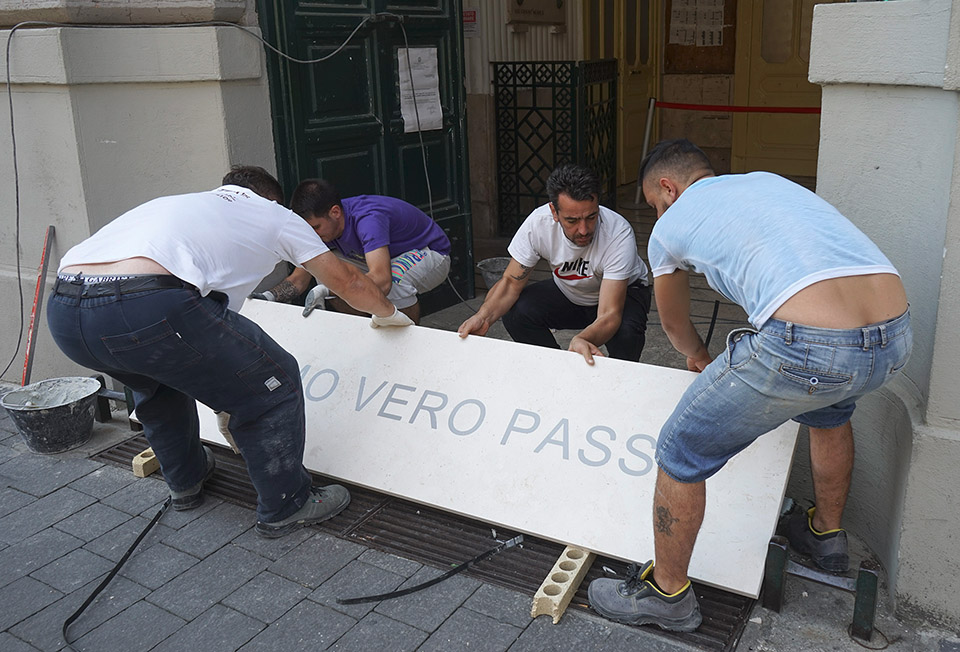
Bianco-Valente, Primo vero passo, 2017, Soglia in pietra di Trani, cm 240 x 61, opera permanente, Liceo Vico, Napoli
For Bianco-Valente, the creative process is a struggle with meaning, a continuous formulation of questions aimed at truly reaching the depth of things in search of answers. It is continuous dialogue, having experiences, daily research in territories that concern not only contemporary art but everything capable of providing stimulus and enrichment: cinema, literature, music, meeting people, the street.
Since their beginnings they have taken part in numerous solo and group exhibitions. Among the large-scale public installations created through engagement with urban reality and the community, we may recall: Ogni dove (Everywhere), 2015, a permanent installation for the Museo A Cielo Aperto in Latronico; Il Mare non bagna Napoli [The Sea Does Not Wash Naples], installed in 2015 on the highest point of the Museo Madre in Naples; Misuro il tempo [I Measure Time] from 2019 in Ischia; A forma di tempo [In the Shape of Time] (2019), curated by Roberto Lacarbonara at Lama Monachile in Polignano a Mare; Nessuno escluso [No One Excluded] in 2020 in Naples; Parla del tuo villaggio [Speak of Your Village] (2022), a permanent installation at Palazzo De Gualtieris/Kora Centro del Contemporaneo, Castrignano de' Greci (LE), just to name a few. Since 2008, together with Pasquale Campanella, they have curated the public art project A Cielo Aperto [Under the Open Sky], developed in Latronico, Basilicata, pursuing the idea of working toward the construction of a diffuse open-air museum, to which is dedicated the book edited by Bianco-Valente and Pasquale Campanella themselves, A Cielo Aperto, pratiche di collaborazione nell'arte contemporanea a Latronico, published in 2016 by Postmedia Books. Protagonists of numerous workshops, labs and seminars, they are mentioned in numerous articles and publications devoted to their work.
They live and work in Naples.
_
Text taken from Pietraverso, master's thesis of Arianna Ladogana at the Accademia di Belle Arti di Bari, 2023.