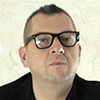
Angelo Bianco, interview with Bianco-Valente, 2014
Bianco-Valente / P. P.*
* texts, thematic interviews, reprints and devices of thought, of reality, processes and actors of the contemporary art debate. Editorial concept Angelo Bianco
For this edition, Page Properties (P.P.) devotes its space/page to the artistic couple made up of Giovanna Bianco and Pino Valente. Conceptually sophisticated artists, among the most interesting on the Italian scene, they carried out, in an initial phase (1996-2003), research aimed at experimenting with the languages of video and electronic imagery, placing perception at the centre of their work as its core theme. Since 2001 they have been testing on themselves the validity of an astronomical-astrological theory, tied to the possibility of influencing future events by reaching, every year on the occasion of their astronomical birthday, a specific point on the globe where time, geographic coordinates and the symbolic structure represented by the arrangement of the Solar System's planets in the sky come together. These studies were followed by a project-based evolution aimed at making interpersonal connections visible, through installation works and projects that, drawing on heterogeneous materials and altering proportions and physical characteristics, become factors in the semantic structuring of the work - generally centred on the relationship between people, events and places, or on the alteration of geographic maps, onto which new layers are superimposed that put the represented places into relation. Their contribution to P.P. is a text structured around the suggestions of nine words - not nine questions, but nine themes from which to recount their own work, for an interview conceived as an exercise in associative memory that leaves the choice of how to structure the account up to them.
Perception > Perception and the interaction of living forms with external reality are the central thread of our research. We've investigated these themes through different expressive means, from the simple act of writing with charcoal on a wall to the creation of complex installations, where artificial entities such as computers are activated to produce phenomena that people perceive as natural. Trying to understand how our perceptual structure works has led us to study the evolution of life forms on earth; the dynamics that keep ecosystems in continuous balance have made us understand how a simple error in the routine copying of genetic code can, in some cases, improve a living being's adaptation to its changing world. We've also sensed the discomfort of scientists who study the complexity of non-repeatable phenomena using a tool as ill-suited to the task as the scientific method.
Nature > This is probably the element we miss most in our everyday lives; we feel a very strong pull towards green spaces, woods and mountains, but we can only afford ourselves the luxury of experiencing them now and then. It may be a strange form of compensation, but many scenes in our early videos are point-of-view shots filmed in meadows or woods, or depict the human figure immersed in nature.
Naples > This is the place where we've chosen to live, a city founded 2,500 years ago on a thin strip of land suspended over two enormous volcanic calderas, ready to erupt at any moment. Depending on the perspective from which one chooses to look at it, Naples can resemble either paradise or hell. Living here, you learn that it's both at once.
Technology > One is constantly tempted to show off the technology at one's disposal in order to create works that amaze the public, but it's a blunted weapon. Becoming too attached to technology, to the point of making it the very meaning of one's own works, leads to works that age quickly (along with the devices that generated them). We believe instead that if technology becomes merely a means for investigating philosophical concepts or the problems inherent to human existence, one can arrive at the formalisation of a work that doesn't fear the test of time.
Ciro Discepolo > Meeting Ciro Discepolo certainly marks a clear before and after in our lives. Ciro is a cultured, pragmatic man, and meeting him and his Active Astrology was the beginning of a long journey that brought us closer to certain forms of knowledge that are part of humanity's cultural heritage - information that has travelled across millennia to reach us. Since 2001 we've been testing his theory of Targeted Solar Returns on ourselves, and the greatest benefit we've gained from it has been acquiring a new awareness of the importance of symbolic combinations, having learned to recognise the right moment to do things, and coming to know deeply our own strengths (and our own weaknesses).
Video > Since we don't paint, and have always had a difficult relationship with the "fine arts", video was the first expressive medium we used to create our imagery.
The analogue video cameras of the mid-1990s were perfect for creating low-resolution images, evanescent and distorted in colour and form - all characteristics that brought them close to the mental image we intended to represent electronically. Using video projections also trained us to handle the exhibition space as if it were a single volume, and to have no fear of very large spaces. Video also led us to set up various collaborations with musicians, and with some of them a very deep bond developed, one that never stops giving us further things.
Photography > Before we met, we had of course both had our own approaches to chemical photography - developing and printing black-and-white photos at home, managing framing, and so on. Video, however, set these inclinations of ours aside for at least a decade, since the evocative fascination tied to the volatility of the electronic image, and its malleability, had become indispensable factors for us. So we only used photography occasionally, as a means of documenting our works. In 2006 we took up the camera again, which had in the meantime become digital.
Public > Our first thought on this word concerns the "public space" we love to engage with. The idea is to set up artworks in a space that doesn't hide behind any door - it can be a square, the junction of a state road, the façade of a building, or, when the occasion calls for it, even the inside of a small-town bar. This gives people the chance to enter into relation with a work of art without the mediation of a designated space that acts as a frame, or that creates a context defined by the "grammar of art" that everyone is otherwise expected to refer to. A work installed in this way is bound to be seen by passers-by who wouldn't normally go to a gallery or a museum and, even more importantly, it can alter the sociality of the public space in which it's installed. This triggers some very interesting implications, and places the artist under the necessity of imagining a work that is "universal" in the deepest sense of the term.
Basilicata > The hidden place, the great green spaces with a few scattered houses, the tenacity with which people cling to land that is difficult to work and that isn't able to offer much. A simplicity able to sweep away, with a single breath, all the uselessness generated by abundance. This land marks, for us, an even more ancestral "return" than returning to the place where we usually live.
_
April 2014