Bianco-Valente, Il libro delle immagini (The Book of Images)
Postmedia Books, 2020
208 pages, 16.90 Euro
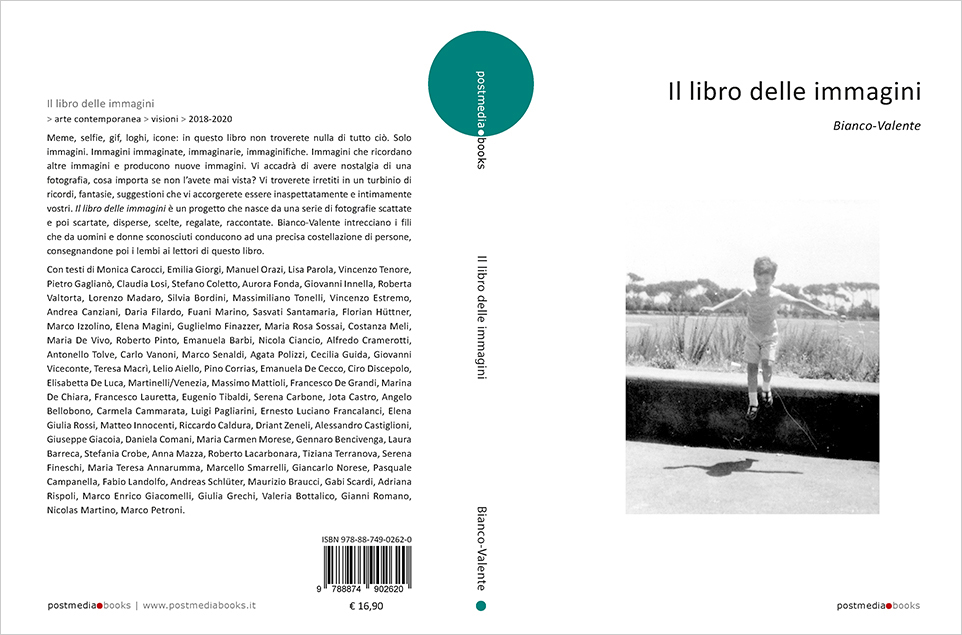
Bianco-Valente, Il libro delle immagini (The Book of Images), Postmedia Books, 2020
An extended experiment on perception, a distributed exhibition, an artist’s book that includes texts by Monica Carocci, Emilia Giorgi, Manuel Orazi, Lisa Parola, Vincenzo Tenore, Pietro Gaglianò, Claudia Losi, Stefano Coletto, Aurora Fonda, Giovanni Innella, Roberta Valtorta, Lorenzo Madaro, Silvia Bordini, Massimiliano Tonelli, Vincenzo Estremo, Andrea Canziani, Daria Filardo, Fuani Marino, Sasvati Santamaria, Florian Hüttner, Marco Izzolino, Elena Magini, Guglielmo Finazzer, Maria Rosa Sossai, Costanza Meli, Maria De Vivo, Roberto Pinto, Emanuela Barbi, Nicola Ciancio, Alfredo Cramerotti, Antonello Tolve, Carlo Vanoni, Marco Senaldi, Agata Polizzi, Cecilia Guida, Giovanni Viceconte, Teresa Macrì, Lelio Aiello, Pino Corrias, Emanuela De Cecco, Ciro Discepolo, Elisabetta De Luca, Martinelli/Venezia, Massimo Mattioli, Francesco De Grandi, Marina De Chiara, Francesco Lauretta, Eugenio Tibaldi, Serena Carbone, Jota Castro, Angelo Bellobono, Carmela Cammarata, Luigi Pagliarini, Ernesto Luciano Francalanci, Elena Giulia Rossi, Matteo Innocenti, Riccardo Caldura, Driant Zeneli, Alessandro Castiglioni, Giuseppe Giacoia, Daniela Comani, Maria Carmen Morese, Gennaro Bencivenga, Laura Barreca, Stefania Crobe, Anna Mazza, Roberto Lacarbonara, Tiziana Terranova, Serena Fineschi, Maria Teresa Annarumma, Marcello Smarrelli, Giancarlo Norese, Pasquale Campanella, Fabio Landolfo, Andreas Schlüter, Maurizio Braucci, Gabi Scardi, Adriana Rispoli, Marco Enrico Giacomelli, Giulia Grechi, Valeria Bottalico, Gianni Romano, Nicolas Martino, Marco Petroni.
From the preface by Brunella Velardi:
Memes, selfies, GIFs, logos, icons: you will find none of that in this book. Only images. Imagined, imaginary, imaginative images. Images that recall other images and produce new images. You will find yourself feeling nostalgic for a photograph — and what does it matter if you have never seen it? You will be caught up in a whirl of memories, fantasies and suggestions that you will realise, unexpectedly, are intimately your own. Il libro delle immagini (The Book of Images) is a project born from a series of photographs that were taken and then discarded, scattered, chosen, given away, told.
Bianco-Valente weave together the threads that lead from unknown men and women to a precise constellation of people, then hand the loose ends to the readers of this book. Pages that stem from the most traditional of art formats: an image enclosed in a frame, because in the age of digital representation and self-representation, of the absolute dominance of visual communication, it can still happen that the most authentic emotion is triggered by an old image — and, what is more, one that is unseen. Thus takes shape a hypothetical exhibition itinerary that unfolds across eighty-four permanent stops, among the studios and homes of the photographs’ new owners.
Review by Maura Picciau, published in Alias / Il Manifesto on 28 March 2020
In Bianco-Valente’s Il libro delle immagini (The Book of Images) there is only one image, the one on the cover: a child jumps down from a low wall in the high, white summer light, and his body casts a sharp shadow on the ground, the silhouette of a childhood flight, when jumping is a need. Behind him, a seascape of pines and water, an impression of wind, and the slightly blurred black and white of the Sixties. Let us keep in mind the visual and physical energy of this shot, because its essence as an anonymous yet evocative photograph, the familiarity that emanates from it, as of a possible childhood, will help us understand. Il libro delle immagini (Postmedia Books, 2020) is the artist’s book that concludes a singular and precious project, conceived and carried out with patient industriousness by Bianco-Valente, a duo of visual and conceptual artists, united in work and in life. In their artistic and existential journeys and wanderings, Bianco-Valente have collected vintage photographs here and there, in flea markets and old bookshops: they are orphan photographs, with no caption, no text or context, no colour and no precise geographical references. Lost documents, clues that are hard to interpret, these photographs are ghosts of something that happened, of lives lived, of stories unknown yet real. Bianco-Valente chose 84 small-format ones, signed them on the back – thereby recognising them as their own works of art and becoming their authors – framed them in light wood, 23 x 23 cm, and sent them to as many people (friends, artists, critics, writers, art historians, architects), then inviting them to return a descriptive text of the photograph they had been given. This gives rise to a double aesthetic level in the project Il libro delle immagini: that of the installation spread across the homes or studios of the future storytellers, and that of the stories arising from their living with, and confronting, the photograph chosen for each of them.
Bianco-Valente have brought to life an intense, evolving relational work because, as they leaf through the more than two hundred pages, readers are called upon to take part in the process of imagining and picturing in their minds the absent photographs. The great absentees, the photos, are strongly present. Readers advance with trepidation along the narrative path, aware that the sequence holds surprises: there are summer tales and autumn tales, tales of children and of women, mothers or wives, of loves and separations, of cars and trains and coaches, of ancient villages and urban suburbs. And there is a rural South, from the 1930s to the postwar period, a luminous and silent Mediterranean, vivid with customs and affections, portrayed before its decline. And so every single photograph, even those whose authors then gave up narrating out of modesty or reluctance, becomes the protagonist of a story that is both historical and literary, in the twofold value that a photographic text (a photo as a document) carries within itself.
Roland Barthes, quoted several times, said that photography “does not necessarily say what is no longer, but only and for certain what has been”: this assumption, the immanence of the event that took place, and hence the emotional interaction of vintage photographs with the present time, underlies the entire project. Collecting old, scattered photographs, selecting them, giving them away, waiting for their descriptions, gathering the stories in a book at an affordable – one might say democratic – price, and offering the final product to the enjoyment of an ordinary public: all of this constitutes and represents an artistic operation of value that deserves attention.
In an age overcrowded with ephemeral, narcissism-afflicted images, Bianco-Valente remind us of the creative and poetic potential of an image to generate new thought and imagination. Reading Il libro delle immagini, one finds oneself increasingly fantasizing about the secret images described, since the descriptive texts lead us to produce new images: imagined, imaginary, imaginative images, as Brunella Velardi puts it in her beautiful preface.
Il libro delle immagini is an original and curious publication in the echolalic landscape of Italian publishing, for its approach of dialogue and listening on a highly topical theme: the contribution of photography to the creation of personal and collective identity. The volume offers a collection of meditations and thoughts on what photography is today, in general, starting each time from one particular photograph. It is thus a gripping essay on the aesthetics of photography, as enjoyable as a work of fiction, which instead conceals an articulate metalinguistic reflection. The work is a cultural proposal all the more commendable at a time when the consumption of photographic images, in the digital and social-media world, makes them evanescent. The publisher Gianni Romano says of Il libro delle immagini that it is “a project that does not end with publication. It is destined to produce encounters between those who took part in it and those interested in enriching that discourse on photography whose boundaries technology and the market are not enough to define”. Bianco-Valente work by subtraction, abstracting the image from the visual field – an act all the stronger for being carried out by visual artists – and bringing the word back to the centre to give birth to new images: a strong and decidedly authorial artistic gesture that aims to widen, as far as possible, the audience of readers/dreamers. An intense book that each reader will make their own, with the impression of remembering or looking through the family photo album again, or of reading a novel with many nameless characters, yet well delineated, albeit slightly out of focus or browned by time.
- Preview of the book (PDF)
- More information on the Postmedia Books website
Reviews:
- Alias / Il Manifesto
- Artribune.it
- Segno
- Exibart
- Artribune Magazine
- Fotocrazia


home | works | texts/testi | video | contacts/contatti